Carroll / Fletcher

Odds & Ends V

“One protests because not to protest would be too humiliating, too diminishing, too deadly.  One protests… in order to save the present moment, whatever the future holds.” John Berger.
.
.

Jem Cohen Retrospective

A real treat programmed by Gareth Evans: the Whitechapel Gallery, Barbican and Hackney Picturehouse are presenting a film and music season for the first comprehensive UK retrospective of Brooklyn-based filmmaker Jem Cohen (b. 1962) from 31 March to 28 May 2015.  Whitechapel press release with full details .

The season starts with a performance at the Barbican on 31 March. Tickets are selling fast .

Whitechapel tickets .

Hackney Picture House tickets .

http://jemcohenfilms.com/

The Gravity Hill Newsreels are screening at The Whitechapel on 11 April.  Jem has a vimeo site with the films here and, as a taster, here’s Gravity Hill Newsreel No. 1:

Time and Revolution

“Every conception of history is invariably accompanied by a certain experience of time that is implicit to it, conditions it, and thereby has to be elucidated.  Similarly, every culture is first and foremost a particular experience of time, and no new culture is possible without an alteration in this experience.  The original task of a genuine revolution, therefore, is never merely to ‘change the world, but also – and above all – to change time.”

Giorgo Agamben, Infancy and History: On the Destruction of Experience (quoted by Marquand Smith in his essay to accompany the exhibition How To Construct A Time Machine at MK Gallery)

jem

Image: Jem Cohen, Still from Gravity Hill NEWSREEL No. 2, 2011


“To make things visible. This and nothing else.” Joseph Conrad.
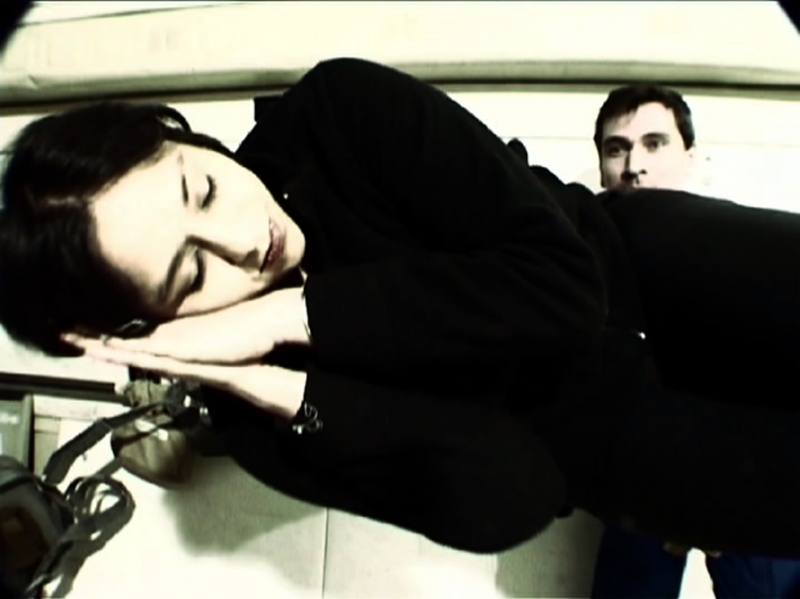
 

Otolith I

The Otolith Group and Richard Couzins

Otolith I

2003, 23’16”

17 March – 23 March 2015


2011021917551 (1)


“There is no memory without image and no image without memory.  Image is the matter of memory.”

Otolith 1

Background

Otolith I is set in the 22nd Century, when the human race is no longer able to survive on earth and is obliged to live in the agravic conditions of the International Space Station. Dr. Usha Adebaran Sagar, the future descendent of Otolith Group member Anjalika Sagar, is an exo- anthropologist researching life on an earth that she can experience only through media archives. Otolith imagines a mutant future that simultaneously harks back to the post war era of non-alignment so as to indicate an connection between the production of commonality in South Asia, USSR and the present. Otolith 1 was the Otolith Group’s first project. It was commissioned by The Arts Catalyst and the M.I.R. Consortium (Arts Catalyst, Projekt Atol, V2, Leonardo-Olats).

Otolith I

Otolith II

Otolith III

Otolith noun

“1. (Gr lithos stone) a calcerous concretion in the ear of various animals, the movement of which helps the animal to maintain equilibrium.”

Source: Chambers Dictionary

Waiting for the Future – Nina Power on the Otolith Trilogy (Frieze Magazine 2010)

“There are more futures than we realize, and more failures too. The past is littered with the debris of these futures, while our present incorporates the unstable collective memory of hopes that have long since been abandoned… [The Otolith Group’s] use of documentary footage, of archives both familiar and alien, provides a melancholy window onto worlds not created and paths not followed… [full article here]”

Courtesy Nina Power and Frieze Magazine.

About the Otolith Group

The Otolith Group was founded in 2002 and consists of Anjalika Sagar and Kodwo Eshun who live and work in London. The work is research based and in particular has focused on the essay film as a form that seeks to look at conditions, events and histories in their most expanded form.

http://otolithgroup.org/

Credits

Directed and Edited by the Otolith Group

Narration – Anjalika Sagar

Camera – Richard Couzins

Script – Kodwo Eshun and Anjalika Sagar

Sound Design – Trevor Mathison and Anjalika Sagar

Sound track – Ekkehard Ehlers, Plays John Cassavetes

Standard 8 Film used by kind permission of Vidya Sagar

Women in Space, British Film Institute, ETV Collection

With Special Thanks to: Chitra Gyan-Chand, Anand Patwardhan, Trevor Mathison, Ewen Chardronnet, Duncan Youngerman, Jean Luc Soret, Natasha Petresin, Kathy Rae Huffman, Vidya Sagar and Michelle Deignan.

Commissioned by The Arts Catalyst and the MIR Consortium

http://www.artscatalyst.org/


Courtesy of The Otolith Group and LUX, London


ODDS & ENDS IV

“The position that an epoch occupies in the historical process can be determined more strikingly from an analysis of its inconspicuous surface-level expressions than from that epoch’s judgement about itself.”

Siegfried Kracauer, The Mass Ornament

Notes on Blindness by Peter Middleton and James Spinney

A moving example of a film in which the images and the script complement each other to provide insights that neither on their own provide.

In 1983, after years of deteriorating vision, the writer and theologian John Hull lost the last traces of light sensation. For the next three years, he kept a diary on audio-cassette of his interior world of blindness.  Notes on Blindness is a dramatization that uses his original recordings.  It was commissioned by the New York Times and premiered at the 2014 Sundance Film Festival.  It won the Documentary Award at Encounters Short Film Festival.  The film and accompanying texts can be found on The New York Times website here.

http://www.notesonblindness.co.uk/

“We go to poetry to be forwarded within ourselves”

Seamus Heaney, The Redress of Poetry

Jenna Sutela – New Degrees Of Freedom

Jenna’s website New Degrees Of Freedom featured as a blogpost in April 2014.  The website has been updated to include Act 3 here.

“In effect, every new link between one’s online and offline identities removes a ‘degree of freedom’…If the body cannot be emancipated online — indeed the Internet has proved to be not virtual enough — let us imagine new modes of existence in the physical world…”

Source: http://newdegreesoffreedom.com

 Birkbeck Institute of Moving Image – Essay Film Festival

Shame I’ll miss the Catherine Grant’s masterclass and screening on Friday 20th March 6.00-9.00pm (although I’m looking forward to being in Berlin for the Lunch Bytes conference with, amongst others Constant Dullaart, Cornelia Sollfrank, Jenna Sutella, Ben Vickers, Hito Steyerl, Melissa Gronlund and David Joselit).  Tickets can be booked .  Dr Catherine Grant (University of Sussex) writes about and teaches media. She is well known for her video essays made of found footage. She also runs Film Studies For Free, a regularly updated web-archive of links to the best resources in moving image studies.  In March 2014, Grant became founding co-editor of [in]TRANSITION, the first ever peer-reviewed journal of videographic film and moving image studies.   Dr Grant will talk about practical aspects of essayistic film-making, its ambitions and frustrations. Her masterclass will be followed by a screening of the essay films produced in the film-making experiment.

http://www.essayfilmfestival.com/

“[literature gives] an experience that is like a foreknowledge of certain things which we already seem to be remembering.”

Seamus Heaney, The Redress of Poetry

 A slight diversion – Marina Warner in LRB “on the disfiguring of higher education”

“All this follows from the changing economics of education policy.  Cuts are the tools of the ideological decision to stop subsidising tuition and to start withdrawing from directly supporting research.  What we are in effect moving towards is the privatisation of research… [read the whole article ]”

Adorno, Minima Moralia

“The haste, nervousness, restlessness observed since the rise of the big cities is now spreading in the manner of an epidemic, as did once the plague and cholera. In the process forces are being unleashed that were undreamed of by the scurrying passer-by of the nineteenth century. Everybody must have projects all the time. The maximum must be extracted from leisure. This is planned, used for undertakings, crammed with visits to every conceivable site or spectacle, or just with the fastest possible locomotion. The shadow of all this falls on intellectual work. It is done with bad conscience, as if it had been poached from some urgent, even if only imaginary occupation. To justify itself in its own eyes it puts on a show of hectic activity performed under great pressure and shortage of time, which excludes all reflection and therefore itself. […] As here, so generally, the forms of the production process are repeated in private life, or in those areas of work exempted from these forms themselves. The whole of life must look like a job, and by this resemblance conceal what is not yet directly devoted to pecuniary gain. […] Doing things and going places is an attempt by the sensorium to set up a kind of counter-irritant against a threatening collectivization, to get in training for it by using the hours apparently left to freedom to coach oneself as a member of the mass.”