Past Screenings

Lucy Parker

Lucy Parker

Writers’ Group

2013, 31′ 32″, HD

1 June – 12 June


Screen Shot 2016-05-31 at 16.24.53


The Writers’ Group Credits

Gabi Norland

Chin Okoronkwo

Anton Kats

Joseph Browder

Vivianne Brown

Billy Clarke

Brian Ferguson

Luke Garbutt

Grethe Mangala Jensen

Dympna Messenger

Roland Watson

Newham Writers

Peter Bedford Housing Association

Richard Hall
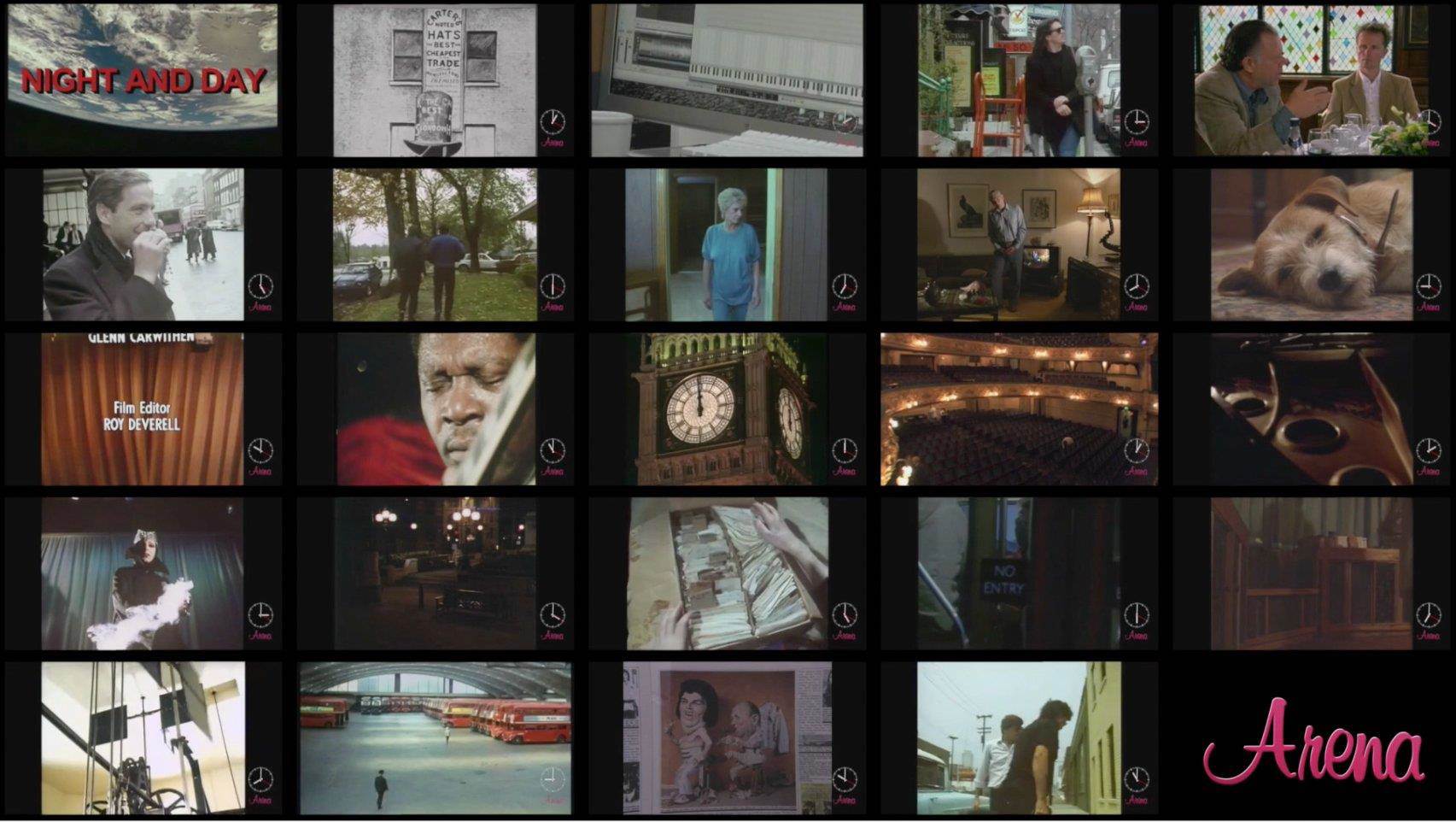
 

Night and Day – The Arena Time Machine

Saturday 28 May, 12pm – Sunday 29 May, 12pm


To celebrate the 40th anniversary of the BBC’s arts documentary strand Arena, the programme’s Series Editor Anthony Wall and Film Editor Emma Matthews have created Night and Day – The Arena Time Machine, a 24-hour audio-visual experience evoking a day in the life of the planet in early summer. Drawn exclusively from Arena’s archive of over 600 films, Night and Day is edited to link the time in the film to the time in the location of the screening – if it’s dawn on the screen, it’s dawn outside the gallery.

“To begin at the beginning…” recites Dylan Thomas, as the darkest hour gives way to dawn over Laugharne, the Welsh fishing village of Under Milk Wood. The sun rises on Mandela’s Robben Island, Van Morrison’s Ulster, Eric Sykes’s London, Sonny Rollins’s New York, Bluefields Nicaragua, the Mali desert and the Iron Curtain; scenes all drawn from Arena films.

The day progresses through work and school, to Lady Naipaul preparing lunch, in parallel with the Rasta community of Bull Bay, Jamaica; and Anita Ekberg who muses over the most beautiful women in cinema, as she seasons the chicken. In Mexico City, Buñuel gives his recipe for the perfect dry Martini; in Montserrat, George Martin gives his. Burroughs and Warhol enjoy Lapin au Moutarde in the Chelsea Hotel; Galton and Simpson take us to their favourite restaurant in Twickenham; Elvis’s relatives catch squirrels in Mississippi; and rock star Cui Jian, whose songs were the anthems of the students in Tiananmen Square, sits at the table with his family in Beijing.

And so the day goes on through the afternoon, to the strange and beautiful hour of the gloaming; to dinner and the attractions of the night through the dreams of George Wendt’s latter day Oblomov, Edna Everage, Ionesco, Roy Plomley, Jean Genet and David Bowie; before returning to the darkest hour just before dawn and Dylan Thomas. The film will be available to stream on laptops, mobiles and tablets via Carroll / Fletcher Onscreen. It will also be simultaneously screened at Carroll / Fletcher’s Eastcastle Street gallery, where visitors are welcome to stay for the whole duration, to drop in, or to keep popping back at different times of the day or night.


24 hour Grid


Arena

Since it was first broadcast in October 1975, BBC TV’s Arena has produced over 600 films, won 9 BAFTA Awards and 25 BAFTA nominations, 6 Royal Television Society Awards, 6 Broadcasting Press Guild Awards, the Prix Italia, a Grammy, Primetime and International Emmys, a Peabody Award and the special medallion at Telluride in 2000. Arena is the world’s longest-running arts documentary strand. The programme is distinguished by an unbroken editorial and aesthetic sensibility, from Leslie Megahey (1977- 79) to Alan Yentob (1979-1985), Nigel Finch and Anthony Wall (1985 until Finch’s death in 1995) and Wall’s sole editorship to the present day. From the first edition in 1975, which featured Laurence Olivier discussing the remarkable life of Lilian Baylis (the founder of the National Theatre) and David Hockney painting sets for the Stravinsky opera The Rake’s Progress at Glyndebourne, Arena has never failed to attract the great names of art, cinema, music, literature and academia. Versions of Night and Day – The Arena Time Machine have been screened at: Telluride Film Festival, USA, 2015; Cambridge Film Festival, UK, 2015; Cambridge Festival of Ideas, UK, 2015; Brighton Film Festival, UK, 2015; Dingle Film Festival, Ireland, 2016; New York University, USA, 2016.


Film Credits: Directors ANTHONY WALL, EMMA MATTHEWS; Film Editor EMMA MATTHEWS; Production Manager CAROLINE SUTTON; Online Producer ALEX JONES; Technical Consultant ANDY ARMSTRONG; Research and Additional Editing ISOBEL GOODRICH; Archive Producer ANDREW WRIGHT; Screening coordinator ROSY RICKETT; Arena Series Editor ANTHONY WALL


let this be us


Richard T Walker

let this be us

2012, 7’44”, single channel video installation

3 May –  11 May 2016

Richard T. Walker, let this be us, 2012, 13. guitar valley valley

“During the making of let this be us I was thinking a lot about the Kelsey essay Landscape as Not Belonging in the book Landscape Theory [ed. Rachel DeLue and James Elkins, 2007]. Kelsey proposes the idea that over time we have fantasised ourselves into a situation whereby we feel alien to the landscape so that we can then desire to ‘belong’ to the landscape. Of course, we are nature, we are not separate from it; we have just conditioned ourselves to think and act this way. I like thinking about a situation where someone, somewhere, against all odds actually becomes ‘one’ with nature. However, because this would mean breaking down so many of the perceptual boundaries that we have culturally constructed, their existence and sense of self becomes very different.”  Richard T. Walker.

Shot in the Anza Borrego desert in Southern California, let this be us is an elegantly composed narrative in which the artist is seen traversing the desert while carrying what appears to be a photograph of the same landscape mounted on a poster board. After apparently aimless wandering, the board is erected on its camera tripod legs and the scene in the poster board photograph and the actual landscape fall into line. Then Walker begins a wordless song that, as the video progresses, gains layers of instruments and voices, both generated within the work and as an added sound track.

The final scene begins with the artist partially obscured behind the poster board sign so that just legs and the back of the head are visible. As the music draws to a close, he walks away towards the horizon, swiftly vanishing entirely behind the sign and into the work/world.

7

Biography

Walker’s films show the artist alone, his back to the viewer, in the centre of a dramatic landscape contemplating the infinite, awe-inspiring mysteries of an impersonal natural world- a position reminiscent of a classic romantic figure. As the film’s narrative unfolds, accompanied by Walker’s musical compositions, viewers find themselves becoming beguiled by the gentle wit and drawn into the artist’s intimate relationships, as he apparently picks over the intricacies of his personal life in the face of an emotionally detached nature.

Describing his work, Walker states, “I think, or I hope, that the viewer becomes simultaneously pushed away and pulled towards the landscape. There is a sort of redemption in the music – the idea of the Sublime is re-appropriated, re-positioned and I think the initial relationship to the Sublime becomes questioned.”

“Although Walker’s work obviously participates in the tradition of ‘land art’, he has staked out a position very much his own. It goes without saying that his practice is at odds with the monumental inscriptive gestures of the first generation of earthmoving American land artists, and even those approaches with which he has common ground – the ambulatory poetics of Hamish Fulton or Richard Long, for instance – still have at their core a subtle yet unmistakeable impulse towards colonisation, even if only linguistic, and a kind of self-seriousness that is in Walker’s work always tempered by a tacit acknowledgement of the absurd mismatch between the individual and the world that is the flip side of any attempt, however serious or lyrical, to draft nature into an artistic programme. Indeed, this disparity lies at the heart of the gently humorous caricature Walker enacts… [more here]” Jeffery Kastner, 2013.

Recent solo shows, group exhibitions and performances include everything failing to become something, Carroll / Fletcher, London; In accordance with things, àngels, Barcelona; the fallibility of intent, Di Rosa, Napa, USA (all 2015); the predicament of always (as it is), The Contemporary Austin, Austin, USA (2014); the predicament of always (as we are), ASU Art Museum, Tempe, USA (2014); the security of impossibility, The Kadist Art Foundation, San Francisco, USA (performance) (2013); in defiance of being here, Carroll / Fletcher, London, UK (2013); let this be us, Des Moines Art Center, Iowa, USA (2013); and Stage Presence, SFMOMA, San Francisco, USA (performance).

www.richardtwalker.net

Richard Walker at Carroll/Fletcher here.

Filmography

an is that isn’t always, 2015
.
.

2011, 9′ 58″, three channel video installation

“… embracing each thing with the type of meaning only words can provide; beautiful and concise, they hide their limitations with perfection. It all begins to seem very predictable as everything manifests all too comfortably inside the guise of recognition. You think how there was no hesitance and how the speed an eagerness of meaning appeared almost desperate. As you try to assemble what is now before you, you mourn a little for what you have lost, for you could never again acquire the not knowing that so beautifully placed you in the centre of it all.” From the speed and eagerness of meaning.

5

“He can’t describe anything he sees because nothing fits into words anymore. He occasionally experiences feelings that are associative to the things in front of him but they exist between and beyond emotions, so translation is impossible. He wants to see things as they were. With the ability to ascribe meaning and names to objects again, finding purpose and justification even if it isn’t true. He wants everything to be just what it was.” From the speed and eagerness of meaning.


outside of all things 

2013, 7′ 51″, two channel video installation

double

In contrast to the configuration of the screens in the speed and eagerness of meaning, in outside of all things the two screens are installed on opposite walls. Although outside of all things and let this be us are stand-alone works that can be exhibited separately, the two works are conceived as companion pieces – the soundtracks of the two works have been designed such that when the works are installed in adjacent rooms the sound bleed between the two rooms harmonises to create a single soundtrack, and the conceptual content and emotional register of the works resonate to create an immersive ambulatory experience in which the audience moves between the two rooms.


proximity of longing, 2013

27 archival pigment prints, 30.7 x 46cm
RTW proximity of longing 3, 2012-md

I have become far too familiar with these places

I have forgotten the beauty of a vista or what is actually meant by a view.

Distance is now just a matter of fact.

A selection of small shapes extracted from a greater series of shapes;

Artefacts that interrupt an otherwise perfect line of sight.

Being here feels like an assertion of every moment.

And I have wanted nothing more than for these few moments to become less and less identifiable;

Acknowledgements of existence that I can project onto, but nothing else.

We have to create a new situation.

One where we can once again convince ourselves that I am alien to all of this.

We need to return to the understanding that I am a completely separate entity.

Then we can long for a time when we can be together again.

For it is within the proximity of longing that I remember the experience of our unity being the most palpable.

We must establish this as a space that exists outside of all the things within it.

Including, most importantly

myself.                       yourself.                      ourself.

Richard T. Walker, proximity of longing,2013, 9