Carroll / Fletcher

Pratibha Parmar

Sari Red

3 July – 13 July

Sari Red

1988, 12 mins, colour

In memory of Kalbinder Kaur Hayre

“Invisible winds carrying words of hatred” Sari Red.

SYNOPSIS

Made in memory of Kalbinder Kaur Hayre, a young Indian woman killed in 1985 in a racist attack in England, Sari Red eloquently examines the effect of the ever-present threat of violence upon the lives of Asian women in both private and public spheres. In this moving visual poem, the title refers to red, the colour of blood spilt and the red of the sari, symbolizing sensuality and intimacy between Asian women.

DIRECTOR”S NOTES

Sari Red (1988) is a video poem, a poetical memorial to the death of one young Indian woman at the hands of racists. It references nationalism, neo-Fascism, Britain in 1980-90s, immigration, hate crimes and fighting back for self and dignity. The video makes a break with the ‘master codes’ of cinema by using culturally specific signs and symbols to create a mise-en-scene of this loss and bereavement.

My work criss-crosses boundaries helping audiences make the connections, think outside of particular, personal points of identity and look at different kinds of struggles with a view to illuminating what it means to not merely to exist but to co-exist.

These connections, across nation, race, gender and ability make for a critical and rigorous examination of identity, empathy and what it means to be human.

The forgotten histories, subjectivities, realities and every day struggles add yet another component. In my work, I have sought to reclaim the overlooked, the censored, the wilfully forgotten, and to reflect these narratives back so that audiences have the opportunity to do the same.


That Moment of Emergence by Pratibha Parmar – quotes from essay published in Queer Looks (1993), edited By Martha Gever, Pratibha Parmar, John Greyson

“By reflecting on my own working practices as a filmmaker and video artist, and in unfolding my personal and historical context, I hope to be able to contribute to the ongoing development of a general theoretical framework for discussing the cultural and political significance of black arts in postcolonial Britain. It is a framework that differs from previous forms of cultural critiques because of the ways in which it seeks to centralize the black subjectivity and our experiences of difference. The more we assert our own identities as historically marginalized groups, the more we expose the tyranny of so-called centre.

I came into making videos and films from a background in political activism and cultural practice, and not from film school or art school. As an Asian woman I have never considered myself as somebody’s ‘other’ nor have I seen myself as ‘marginal’ to an ubiquitous, unchanging, monolithic ‘centre’.

There is a particular history that informs the thematic concerns of my work as much as my aesthetic sensibilities. That history is about forced migration to an England that is intensely xenophobic and insular, an England that is so infused with outdated notions of itself as the Mother Country for its ex-colonial subjects that it refuses to look at the ashes of its own images as a decaying nation, let alone a long-dead empire.

When my family, like many other Indian families, arrived in Britain in the mid-sixties, anti-black feelings were running high and ‘Paki-bashing’ was a popular sport amongst white youths. It was in the school playground that I first encountered myself as an undesirable alien, objectified in the frame of ‘otherness’. All those of us perceived as ‘marginal’, ‘peripheral’ and the ‘other’ know what it is like to be defined by someone else’s reality and often someone else’s psychosis.

We can read ourselves against another people’s pattern, but since it is not Ours…we emerge as its effects, its errata, and its counter narratives. Whenever we try to narrate ourselves, we appear as dislocations in their discourse. Edward Said4”

“I do not speak from a position of marginalization but more crucially from the resistance of that marginalization. As a filmmaker, it is important for me to reflect upon the process through which I constantly negotiate the borderlines between shifting territories…between the margin and the centre…between inclusion and exclusion…between visibility and invisibility”

“What we have been seeing in recent years is the development of a new politics of difference, which states that we are not interested in defining ourselves in relation to someone else or something else, nor are we simply articulating our culture and sexual differences. This is not a unique position, but one that is shared by many cultural activists and critics on both sides of the Atlantic. We are creating a sense of ourselves and our place within different and sometimes contradictory communities, not simply in relation to…not in opposition to…not in reversal to…nor as a corrective to racism and homophobia, we locate ourselves not within any one community but in spaces between these different communities.”

The website of Pratibha’s production company, Kali Films, can be found here

A FEW QUOTES FROM ELSEWHERE

“At the same time, red and blood denote positive images of the survival of Indian cultural traditions, traditions that celebrate red as the colour of India, of the Great Goddess of India, of “the very essence of energy, of joy, of life itself” (Erikson). Red is the colour of women, of femininity, the colour of the clothing of Indian women, the sari.” Women Film-makers of the African & Asian Diaspora: Decolonizing the Gaze, Locating Subjectivity, Gwendolyn Audrey Foster.

“The video works most sharply, however,by repetition and accumulation. The phrase “blood against the wall” reoccurs on the soundtrack, and red liquid splashed on a brick wall reiterates as an image. These are not nature’s consoling repetitions. They are cold, piercing warnings. At times images overlie each other. reducing simplicity and complicating reality. And at times voices tumble, echoing, vibrating suggesting various perspectives on the awful event.

The complexity of the aesthetics, including the visual superimpositions and overlapping of sounds, in addition to the poetic, repetitive quality of both the images and the voice-over, makes us aware of representation as representation. The vision of the world in Sari Red is clearly contingent on the where and when of the video’s maker. As if she were following Ruby’s directive, Pratibha Parmar gives her images of the world in such a way that we understand them to be dependent on her political and social situation, as well as her intellectual and aesthetic mission. Born in the resistance and opposition to singular views of lived experience, the video is part of a larger social movement to query the construction and proliferation of one dimensional views of cultural identity.” Crafting Truth: Documentary Form and Meaning, Louise Spence and Vinicius Navarro.

BIO

For a profile of Pratibha see the website of her production company, Kali Films

FILMOGRAPHY

FEATURES

2013 Alice Walker Beauty in Truth
2006 Nina’s Heavenly Delights

SHORTS

2008 Playing Dead
2000 Sita Gita
1997  Wavelengths
1994  Memsahib Rita

DOCUMENTARIES

2008 Diversity in Motion
1998 The Righteous Babes
1990 Brimful of Asia
1996 Jodie: An Icon
1994 The Colour of Britain
1993 Warrior Marks
1992 Double Trouble Twice The Fun
1991 A Place of Rage
1991 Khush
1990 Flesh and Paper
1990 Bhangra Jig
1989 Memory Picture
1988 Sari Red
1987 Reframing AIDS
1986 Emergence

CREDITS

Actress: Chila Kumari Burman

Voiceover: Shaheen Haque

Other Voices: Gurinder Chadda, Paul Adabie, Pratibha Parmar and Rashid Meer

Slides: Southall Black Resistance – Chila Kumari Burman and Keith Piper

Researcher and Production Assistant: Jemini Pandya

Soundtrack: Trevor Mathieson

Camera: Pratibha Parmar

Editors: Bruna Fionda and Pratibha Parmar

Post Production: Anarres Video

Written and Directed: Pratibha Parmar
 

Saodat Ismailova

Zukhra

Zukhra

23 June – 2 July

2013, 32 min, HD video

Conceived as a looped installation for the Central Asian Pavilion at the 55th Venice Biennale, 2013.

ZUKHRA

In Uzbek, the planet Venus or the morning star that appears fleetingly in the twilight; also ‘bright, beautiful, shining’.

For women in Uzbekistan Zukhra represents love, wish, and desire.  Legend has it that a young girl, Zukhra, mysteriously disappeared and reappeared in the sky as a star. Since then, when an Uzbeki woman is seeking for a wish to be granted she confronts the morning star, Zukhra, in solitude at dawn.

SYNOPSIS

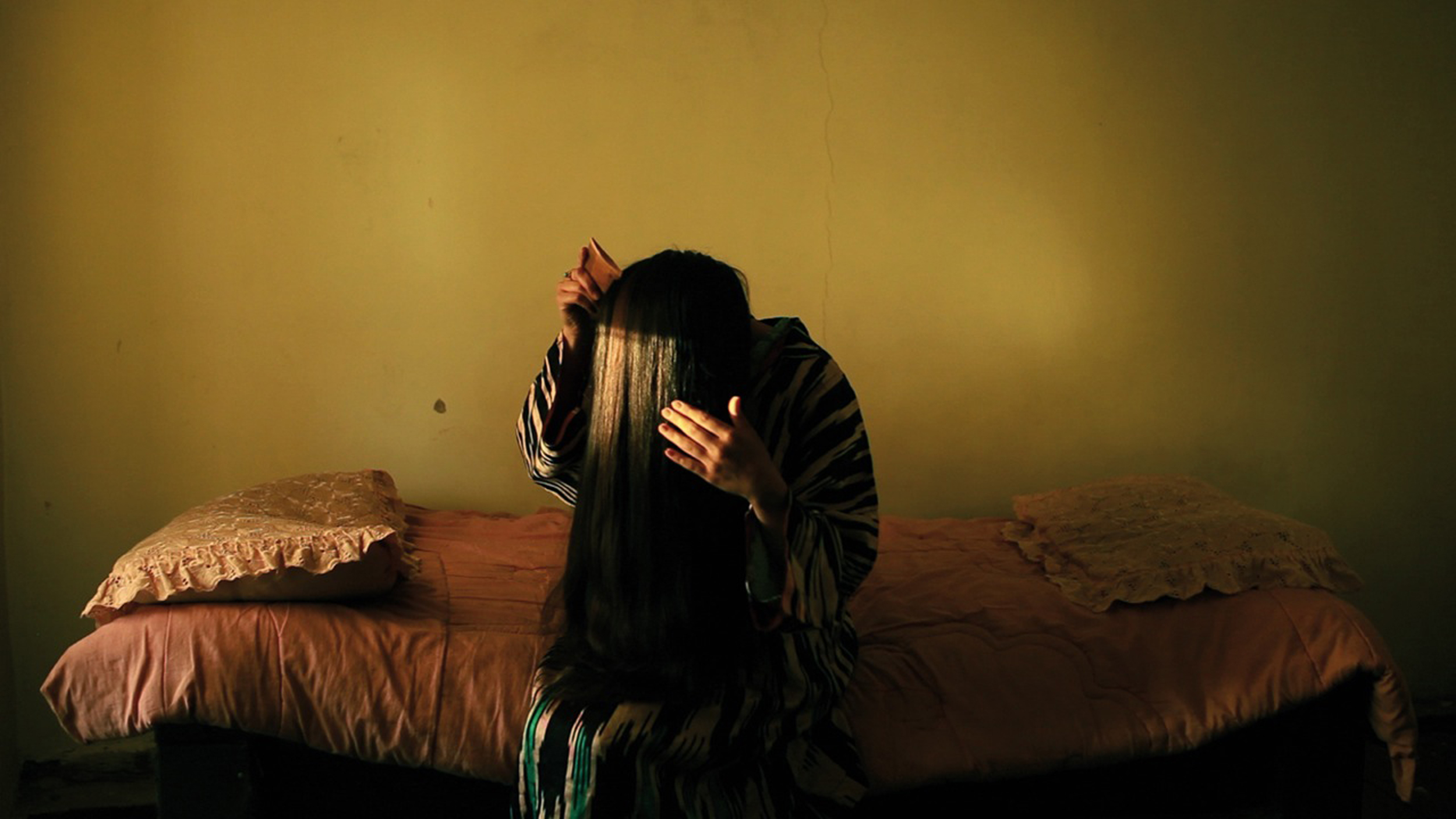
In Zukhra we see a young woman sleeping; a deathbed scene in a central Asian house with mud walls and a bed made of 40 korpas*, illuminated by the shimmering light of a stuttering electrical flow. The woman has entered a lethargic dream, her soul stolen by spirits. The only way to call it back is through a jahr – a Central Asian exorcism ritual that dictates the fate of the soul; memories of the past inhabit the mind of sleeping Zukhra – a ‘Sleeping Beauty”, an “Ophelia of Central Asia” that awakes to her own death, the winter of her soul.

We hear the sound of her heart beating, her dreams, even her memories. The sounds change like the whispering of the angel sitting on the right shoulder** and the trembling sounds of the angel on the left.  We can come to know her by the sounds of her past.  The room is filled by those sounds, sounds that appear as re­collections of the history of Uzbek women, of Central Asian women, of a woman that lived in the verge of the soviet as an independent spirit.  We are suspended in a time of our own without a destiny, without history, in a lethargic dream, in a state of floatation, between good and evil, married to our own death, in the winter of our soul.

*In Uzbek tradition a woman recently married sleeps atop 40 korpas (traditional matrasses) and everyday of her chilla or vow, one korpa is removed.

**Kiraman Katebinin: the Islamic tradition of honou­rable scribes, are the angels sitting on our shoulders, the right angel is the one who records our good deeds and the left one the bad.

DIRECTORS NOTES

Zukhra was shot in the deathbed of my grandmother, in my family house in the old city of Tashkent in 2013.

Every lived moment, sound and word heard, memory forgotten, leaves an indelible mark on us that goes deep under our skin forever. In maturity we become a being that reflects each moment lived and witnessed. In my interpreta­tion of the well-known Central Asian legend Zukhra, which centres on a female character that recalls Shakespeare’s Ophelia, I would like to talk about death as a way to exorcise my memories as a woman born and grown up in Central Asia in the crossover times between the fall of the Soviet Union and the awakening of a new unknown identity. While thinking on the concept of winter I dreamed of women hibernation, of sleeping beauty, of freezeing the exact moment where we become women – a suspended instant – and the concept of the winter of the soul.

I was brought up by my grandmother that for me was and still is the carrier of womanhood, a woman that no longer exists, a woman that for me lives suspended in my memories of her, of her voice telling me things, whispering me orders, laws, superstitions beliefs that somehow have been transmitted from her to me through whispers, whispers that form the shape of my spirit and soul.

Zukhra somehow wants to bring alive that image of the woman, that suspended ghost of Central Asian woman that we have lost and that somehow lives in all of us, as we live suspended in this lethargic dream, in this non reality.

In Zukhra there are some recurrent themes: dreams, death, exorcism, lethargy, womanhood, feminine awakening and annihila­tion, deathbed, the last breath, rebirth, apathy.

Dreams are a very important fabric of the Central Asian soul, they are a bridge to the past and to the future, and they contain a key to understanding who we are and where we are going, that is why I work on the idea of reproducing dreams, using sound, recreating those whispers that are the memory of my grandmother and possibly of all women.

THE LEGEND

Every night Zukhra secretly left her house.  Her family began to suspect the girl was in love, so the girl’s brother decided to follow her to see who her lover was.  He took a knife ready to punish his sister.  Zukhra walked out of the village, through fields and gardens, towards the mountain.  At the entrance to a cave, she turned and looked at her brother, who, having seen his sister hesitate and begin to turn around, was hiding behind a tree.  Zukhra entered the cave and never came out.  Her brother looked everywhere for her, but Zukhra had disappeared.

With her last breath she whispered: “I am the last light that makes it ‘til the morning”, then became a star.  Since then she shines every night side by side with the moon, lighting the way for all girls.

BIO

Born in Tashkent, Uzbekistan in 1981. Saodat studied filmmaking at the Tahskent State Institute of Arts before working at the Fabrica research centre in Treviso, Italy, where she direc­ted several projects, including Aral, Fishing In An Invisible Sea (2004) and a series of video installations.  In 2014, Saodat’s first feature-length film – Chilla, 40 Days Of Silence – premiered at the Berlin Film Festival.  Her first solo exhibition – Celestial Circles – opens in September 2014 at Kuntsammlungen, Augsburg, Germany.

FILMOGRAPHY

2002 – Zulfiya (15 min.)
2004 – Aral, Fishing in an Invisible Sea (52 min.)
2008 – Avalanche (70 min.)
2009 – In the Shrine of Heart (24 min.)
2013 – Navruz (20 min.)
2014 – Chilla, 40 Days of Silence (84 min.)

CREDITS

Saodat Ismailova – director, editor and sound
Carlos Casas – photography
Dildora Pirmapasova – Zukhra

Download a PDF relating to Zukhra here


Katrina McPherson and Simon Fildes

The Time it Takes

16 – 22 June

2013, 09:44 mins

SYNOPSIS

Shot on location on the stunning west coast of South Uist in Scotland, The Time it Takes features dance artists Simon Ellis (NZ/UK) Dai Jian (China/USA) and Rosalind Masson (Scotland/Germany).

the time it takes

to arrive
to live
to make a land
to find
to fall
to settle in
to work
to build
to seize the day
to journey
to be happy
to make a story
to danceto pick up the pieces
to laugh
to sing a song
to love
to grow
to bury the dead
to lose
to uncover the past
to walk
to imagine the future
to leave
to returnthe time,it takes

A Short Interview – Simon Fildes with Erin Malley from the San Fransisco Dance Film Festival

What is the title of your film to be screened at the SFDFF?
The Time it Takes

What was the inspiration for your film? A movement, an Image, or a story? Or none of those?
An archaeological find in the outer Hebrides (Scotland).

What kind of camera did you use to shoot it?
Shot on HD 1080 50i – Panasonic AF101 (with a ninja data recorder)

Summarize your film in 3 words.
Time – Life – Death

What color is your film?
Rich earthy hues of green and brown with touches of red

What does it taste like?
It tastes like a good single malt scotch whisky with an oatcake and honey on the side

What did you learn during the creation process of this film?
The weather is a great editor.

Credits:

Dance artists: Rosalind Masson, Simon Ellis, Dai Jian
Camera: Katrina McPherson
Editing: Simon Fildes
Music: David Lintern & James Weaver
1st A.D. & digital workflow: Sabine Klaus
Production Assistants: Ben Estabrook & Tanja London
Production Runner: Mairi Thomson
Seamstress: Ciorstaidh Monk
Colour grade: and mastering : Jim Allison
Dubbing mixer: John Cobban
Thanks to: Andy Mackinnon, Paul McCallum, Ronnie Mackinnon,
Ceolas – ceolas.co.uk,
Stòras Uibhist- storasuibhist.com,
Polochar Inn – polocharinn.com,
PlanB planbcreative.org
Eilidh; Issy & Sylvia McPherson, Kirstie Simson
Music tracks: “Firehills” & “Mont E”. warriorsquares.co.uk
Shot on location: Isle of South Uist, Outer Hebrides, Scotland
Funded by Creative Scotland creativescotland.com & Goat Media go-at.co.uk
Directed and Produced by Katrina McPherson & Simon Fildes
© 2013