Carroll / Fletcher

A few articles (and a song) to complement the Exile season

“…But in Said’s insistently political sense, modernity-as-exile – as glimpsed in Lamia Joreige’s recent film, A Journey (2008), which shows a Palestinian refugee camp in 1948, the year of Isreal’s founding – identifies a counter-narrative and the repressed figure of the last century’s otherwise celebrated glorious nationalisms, utopian political projects and vaunted technological achievements; for it reveals their failures, their human wreckage, the costs of their obscene audacity.

I would like to open up that counter-narrative and that repressed figure here, yet avoid reading exile exclusively in the negative, as solely melancholic or chaotic, its identity metaphysically inscribed”

Courtesy T J Demos and Tate Britain.  More of T J Demos’ lucid, stimulating writing on exile can be found .

What’s the Time, ?

“My roommates and I received a letter in the mail the other day. It was addressed to “The owners of: [address of our building].” I opened it and it said:

Real estate urgently needed!Dear Owner,
Are you considering selling your house? Please let us know. Together with our partner, PlanetHome, we are urgently looking for houses, apartments, and properties, private and commercial.Kind regards,
UniCredit Bank AGP.S. If you know of somebody and your reference leads to a successful sale through PlanetHome, we will give you 500 Euros!

I assume that every household in our neighborhood, Berlin’s east Kreuzberg, received a similar letter”

Courtesy of Natascha Sadr Haghighian and e-flux journal.

An interlude

Courtesy of The Doors and YouTube.

“On the desk in front of me, I’ve got a certified copy of Mohamed Sakr’s birth certificate. Born at Newham Maternity Hospital, Forest Gate, East London, on the sixth of February, 1985, Mohamed Sakr’s birth was registered on the 18th of the same month, and the document gives his parents’ names: Gamal and Eman. Forest Gate is the other side of the city, 10 miles and a number of other measures away from where I was born and grew up in Southwest London. But it’s still my city, my country.

…Sakr is believed to be the first British-born person to be stripped of his or her nationality in modern times. Seventeen months after his citizenship was removed, on February 2012, former British citizen Mohamed Sakr was killed in a US drone strike in Somalia”

Courtesy James Bridle and Walker Art Center.

See also James’ work , part of the Science Fiction: New Death exhibition at FACT, Liverpool.


Blight

John Smith, Blight

24 July – 6 August

John Smith

1996, 16mm film transferred to video, 4:3, colour, stereo sound; 14 mins

Blight was made in collaboration with composer Jocelyn Pook. It revolves around the building of the M11 Link Road in East London, which provoked a long and bitter campaign by local residents to protect their homes from demolition. Until 1994, when our houses were destroyed, both the composer and I lived on the route of this road. The images in the film are a selective record of some of the changes which occurred in the area over a two-year period, from the demolition of houses through to the start of motorway building work. The soundtrack incorporates natural sounds associated with these events together with speech fragments taken from recorded conversations with local people. Although the film is entirely constructed from records of real events, Blight is not a straightforward documentary. The film constructs stories from unconnected fragments of sound and image, bringing disparate reminiscences and contemporary events together. Like much of my earlier work, Blight exploits the ambiguities of its material to produce new meanings and metaphors, fictionalizing reality through framing and editing strategies. The emotive power of music is used in the film to overtly aid this invention, investing mundane images with artificial importance. A specific ‘real’ context for the depicted events only becomes apparent at the end of the film. What is presented is simultaneously fact and fiction.”  John Smith

”In the first few minutes of his film Blight, derelict houses appear to be dismembering themselves. Bricks rattle, mortar falls, and wooden beams are dislodged, seemingly by poltergeist activity (a feeling reinforced by a poster for the film The Exorcist, on a bedroom wall that has become newly exposed to daylight). The claw of a bulldozer is filmed, ominously caressing a chimney stack it is about to tear down. But the shot stops short, and the inevitable destruction happens in our heads, not on the screen. The restraint of John’s editing beautifully undercuts the emotive quality of the music (composed by his collaborator Jocelyn Pook), and the music in turn replaces the drama that hits the cutting room floor.” Cornelia Parker ‘John Smith’s Body’ in John Smith: Film and Video Works 1972-2002.

AWARDS FOR BLIGHT

14th Hamburg International Short Film Festival, Germany, 1998 Best International Short Film
42nd Cork International Film Festival, Ireland, 1997 Best European Short Film
40th Leipzig International Documentary and Animation Festival, Germany. 1997 Golden Dove (best short documentary)
33rd Chicago International Film Festival, USA, 1997 Gold Plaque (best experimental film)
16th Uppsala International Short Film Festival, Sweden. Film Jackdaw (best experimental film)
43rd Oberhausen International Short Film Festival, Germany, 1997 Prix Regional and Youth Film Prize
3rd International Biennale of Film and Architecture, Graz, Austria, 1997 Special Critics Award
2nd Bangkok Experimental Film Festival, Thailand, 1999 Audience Prize

BIO

John Smith was born in Walthamstow, East London in 1952 and studied film at the Royal College of Art. Initially inspired by conceptual art and the structural materialist ideas that dominated British artists’ filmmaking during his formative years, but also fascinated by the immersive power of narrative and the spoken word, he has developed an extensive body of work that deftly subverts the perceived boundaries between documentary and fiction, representation and abstraction. Often rooted in everyday life, Smith’s meticulously crafted films rework and transform reality, playfully exploring and exposing the language of cinema.

Since 1972 John Smith has made over fifty film, video and installation works that have been shown in cinemas, art galleries and on television around the world and awarded major prizes at many international film festivals. His solo exhibitions include Figge von Rosen Gallery, Cologne (2013), Tanya Leighton Gallery, Berlin (2013), Kestnergesellschaft, Hanover (2012), Turner Contemporary, Margate (2012), Weserburg Museum for Modern Art, Bremen (2012), Uppsala Art Museum, Sweden (2011), PEER Gallery, London (2011), Pallas Projects, Dublin (2011), Royal College of Art Galleries, London (2010), Tanya Leighton Gallery, Berlin (2010), Sala Diaz Gallery, Texas (2010), Ikon Gallery, Birmingham (2006), Kunstmuseum Magdeburg (2005), Open Eye Gallery, Liverpool (2003) and Pearl Gallery, London (2003). Major group shows include ‘Constellations’, Tate Liverpool (2013-14), ‘Image Counter Image’, Haus der Kunst, Munich (2012), ‘Has The Film Already Started?’, Tate Britain (2011-12), Berlin Biennial (2010), ‘The Talent Show’, Walker Art Center, Minneapolis and MoMA PS1, New York (2010), Venice Biennale (2007), ‘A Century of Artists’ Film in Britain’, Tate Britain (2004), ‘Live in Your Head: Concept and Experiment in Britain 1965-75’, Whitechapel Gallery, London (2000) and ‘The British Art Show’, UK touring exhibition (1984). John Smith regularly presents his work in person and in recent years it has been profiled through retrospectives at film festivals in Oberhausen, Tampere, St. Petersburg, La Rochelle, Mexico City, Uppsala, Cork, Regensburg, Karlstad, Winterthur, Bristol, Hull and Glasgow.

John Smith lives and works in London. He teaches part-time at the University of East London where he is Professor of Fine Art. In 2011 he received a Paul Hamlyn Foundation Award for Artists and in 2013 he was the winner of Film London’s Jarman Award. His work is held in numerous collections including Arts Council England, Tate Gallery, Ella Fontanals-Cisneros, Kunstmuseum Magdeburg, Ferens Art Gallery and Wolverhampton Art Gallery. He is represented by Tanya Leighton Gallery, Berlin.

FILMOGRAPHY

A complete filmography can be found here.

LINKS

CREDITS

Director: John Smith
Producer: David Stacey
The Arts Council of England
BBC
Scenario: John Smith, Jocelyn Pook
Photography: John Smith, Patrick Duval
Editor: John Smith
Sound design: John Smith, Jocelyn Pook
Music: Jocelyn Pook


Collapse and Contingency

Collapse

Basel Abbas and Ruanne Abou-Rahme

Collapse, 8’20”2009

Contingency, 6’48”, 2010

ARTISTS’ NOTES ON THE WORKS

Contingency (2012)

A field of noise. We must keep the order. Low-frequency machine rumble.
A body stuck in a turnstile. Distortion. Metal clanks against metal.
Speakers vibrate, a disembodied voice, an order to MOVE BACK. The machine begins the rhythm again.

Contingency explores the sonic fabric of colonial structures as embodied in the experience of the Ramallah-Jerusalem checkpoint Qalandia.

Using only sounds and dialogue recorded on location with hidden handheld devices the sonic language of the space is decoded and denormalised. Fragments of the conversations and confrontations on site run across the screen. The soundscape is denaturalised to expose an unsettling surrealism and a kind of ‘science fiction’ that lurks at the heart of contemporary coloniality.  Critically examining how colonial practices of disciplining populations not only result in acts of resistance but paradoxically also elicit corresponding modes of self-disciplining by colonial subjects. A disconcerting reference to the ‘machine’ returns again and again in the interactions.

Contingency was originally produced in 2010 as an 8 minute 4 channel sound installation with a minimum of 3 LED tickers running around the perimeter of the room.

Collapse (2009)

8’20” single channel video & sound installation

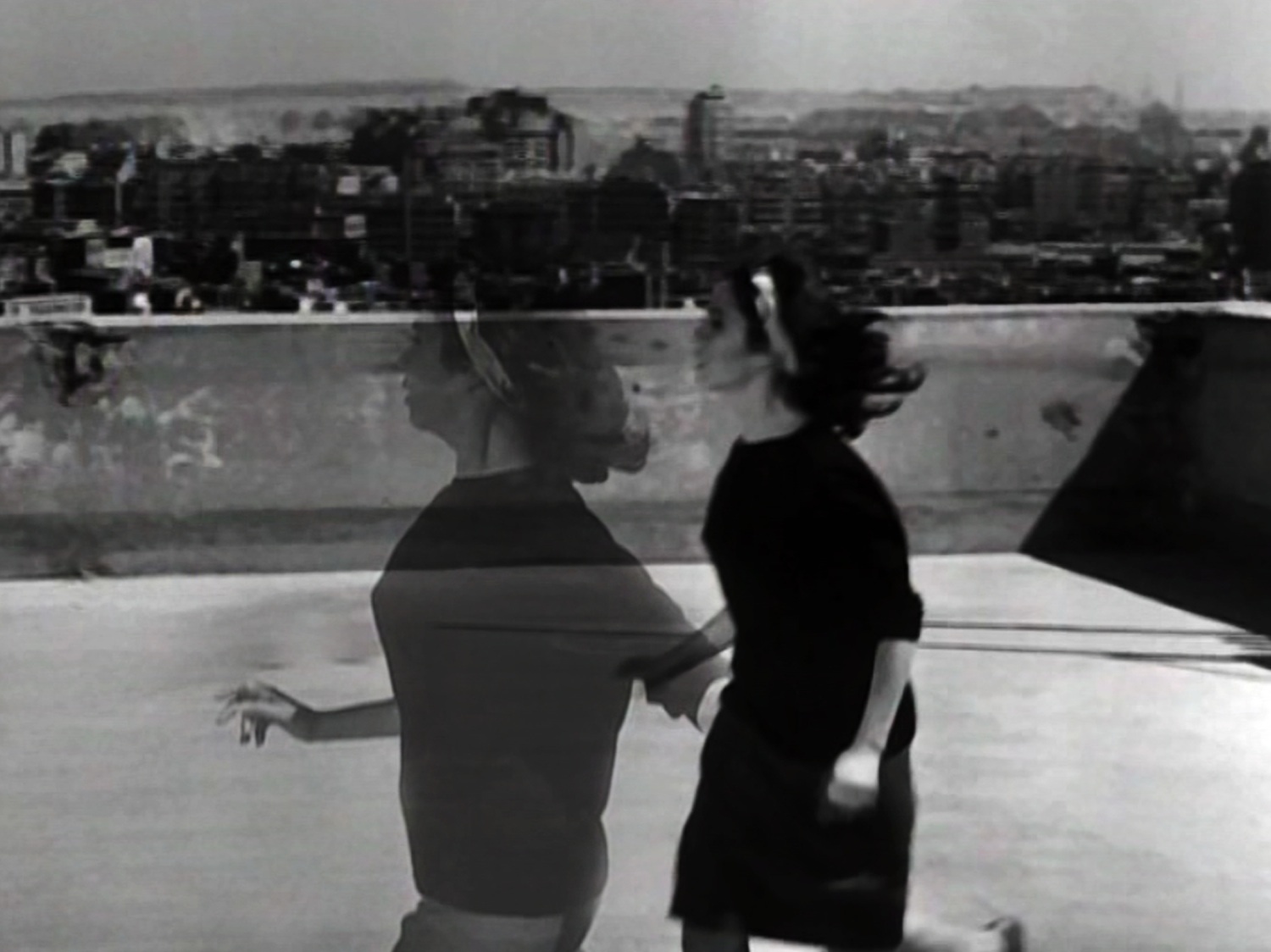
Collapse brings together imaginary and actual moments of resistance and loss, an act of excavation that illuminates the deep disruptions that have shaped not only Palestinian lived experience and memory but shared histories of struggle.

A literal and poetic displacement resonates throughout the work, in part a meditation on a contemporary Palestinian landscape ruptured by a breakdown of community, memory and narrative. The feeling of continual suspension and relapse, progress and deadly repetition is played out exploring the overlap between personal trajectories and multiple historical narratives. It is in the ambiguities between absence and presence, nostalgia and an altogether frustrating sense of deja-vu, that the installation explores an anxious and obsessive state of being, trapped in the transition between past, present, reality and fiction.

AN INTERVIEW WITH THE ARTISTS

Yvette Greslé: Tell me about Collapse, one of the films selected for the screening of artist’s films at Carroll/Fletcher. Watching the film, I was struck by a sense of violence and power and how these, enacted in times of war and political conflict, produce a highly affective relationship to space. It made me think about how space is navigated, whether the space of a city or a landscape (or perhaps even an intimate space, such as a domestic space, or the artist’s studio in your work The Accidental Insurgents). Watching Collapse I felt and experienced the disorientation of displacement, and anxiety, through the (often ghostly) overlays of spatial environments and running men and women. It is such a complex and deeply affecting work, both visually but also in the way that you use overlays of sound.

BA and RA-R: Collapse is a work we finished in 2009. We began working on it in 2008 when we returned to Palestine having not lived there for about 7 years. We both left during the Second Intifada (which began in 2000) and went abroad to study. We lived and worked abroad and were then compelled to go back to Palestine for our work. When we returned we had to deal with quite violent and radical transformation. Not only spatially. Although you are right, there is a sense of how these transformations are visualised and how they manifest spatially. There was also a feeling that there was a loss of a political community or a shared narrative of resistance. It felt as though there was a very deep geopolitical fragmentation of sorts. And a stagnation. We thought about landscape in that sense. As a kind of breakdown of community, and also of memory.

When we left Palestine at the moment of the Second Intifada there was still this discourse of resistance. Or perhaps the remnants of it – a discourse of resistance and liberation. It was the end of the transformation of the PLO (Palestinian Liberation Organisation) into an authority. Before, the idea of the PLO was of something very much alive, and part of a community. When we returned the failures of the Second Intifada had solidified and this marked the end of the PLO or the end of the idea of the PLO. This was quite a radical turning point in terms of the Palestinian narrative, or the discourse which was shaping the narrative.

© writing in relation 2014

The full interview can be found here

FRIEZE STUDIO VISIT

“In Contingency (2010), the duo explored the sonic particularities of the Qalandia checkpoint, the portal between Jerusalem and Ramallah in the West Bank (the artists’ hometown), and one of the most visually documented structures of recent years. The darkened installation plunges the visitor into a field of sound which pulses in tandem with dialogues on ticker-machines that criss-cross the space high above – material recorded by the artists on location with handheld devices. The deep rumbling of the security machines, the staccato clicking of the turnstiles and the metallic voices issuing instructions across the loudspeakers, orchestrate a stark reminder of the ability of sound to affirm disciplinary power. However,Contingency goes beyond the sonic documentation of a piece of military apparatus, capturing paradoxical instances of self-discipline as well as unexpected moments of individual resistance and comic absurdity. At the heart of this denatured and fragmented aural and textual landscape lies a dizzying sense of the fantastical, and a critical reading into the murky presence of fictive dystopias within the everyday trappings of occupation.”

Courtesy Katya García-Antón and frieze magazine.

The full article can be found here

CREDITS

Collapse
Produced with the support of the Delfina Foundation London and Rose Issa Projects London.

Contingency
Courtesy of the artists and or-bits.com
Produced by or-bits.com for the online exhibition Accordance (2012) – http://www.or-bits.com/accordance.php
Text animation by Kuba Nowak.
The installation version was produced with the support of Ashkal Alwan (Beirut).

LINKS
Documentation of the installation version of Contingency https://vimeo.com/35809043
The artists’ tumblr http://ruanne-basel-log.tumblr.com/
The artist’ page at Carroll / Fletcher http://www.carrollfletcher.com/artists/63-Basel-Abbas-and-Ruanne-Abou-Rahme/overview/

Contingency: Courtesy of the artists and or-bits.com
Produced by or-bits.com for the online exhibition Accordance (2012)