Carroll / Fletcher

The Black Dog’s Progress, Magnetic Movie and Anomalies

1- 3 September 2014

Stephen Irwin

The Black Dog’s Progress

2008, 3’14”

the-black-dogs-progress

SYNOPSIS

A series of flipbooks tell the sad story of the Black Dog.

The sad story of the Black Dog is told within a single shot using a series of flipbooks. The scene grows denser as looped scenes accumulate and the narrative develops.

The Black Dog, unwanted by his owner, is thrown out into an unwelcoming neighbourhood. On his journey he is corrupted by acts of violence and grows determined to live happily ever after back home. Unfortunately Mother has different plans and his story ends in tragedy.

LINKS

Artist’s website, about page – http://www.smalltimeinc.com/p/a-b-o-u-t.html

Stephen Irwin interview – http://www.animateprojects.org/films/by_date/films_2008/atv_s_irwin

The Black Dog’s Progress by Karen Alexander – http://www.animateprojects.org/writing/essay_archive/k_alexander_3

CREDITS

A film by Stephen Irwin

Music by Sorenious Bonk


Semiconductor, Magnetic Movie

Semiconductor

Magnetic Movie

2007, 4’42”

SYNOPSIS

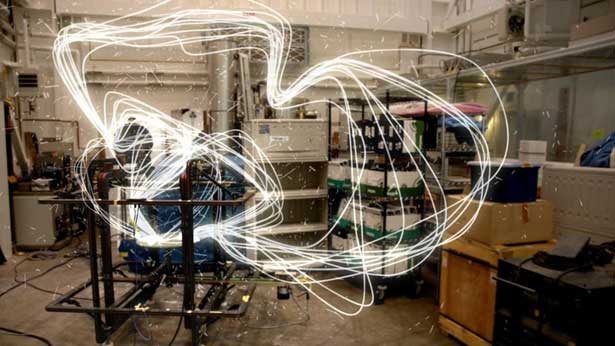
Natural magnetic fields are revealed as chaotic, ever-changing geometries as scientists from NASA’s Space Sciences Laboratory excitedly describe their discoveries.

All action takes place around NASA’s Space Sciences Laboratory, UC Berkeley, to recordings of space scientists describing their discoveries. Actual VLF audio recordings control the evolution of the fields as they delve into our inaudible surroundings, revealing recurrent ‘whistlers’ produced by fleeting electrons. Are we observing a series of scientific experiments, the universe in flux, or a documentary of a fictional world?

LINKS

Creators project – http://thecreatorsproject.vice.com/en-uk/creators/semiconductor

Semiconductor website – http://semiconductorfilms.com/

Semiconductor interview – http://www.animateprojects.org/films/by_date/2007/atv_semi

CREDITS

A film by Semiconductor: Ruth Jarman & Joe Gerhardt

Photographed and Recorded at the Space Sciences Laboratory UC Berkeley

Space Physicists in order of appearance: Janet Luhmann, Bill Abbett, David Brain, Stephen Mende VLF Radio Recordings Stephen P McGreevy


Screen Shot 2014-09-04 at 11.49.54

Atsushi Wada

Anomalies

2013, 2’59”

SYNOPSIS

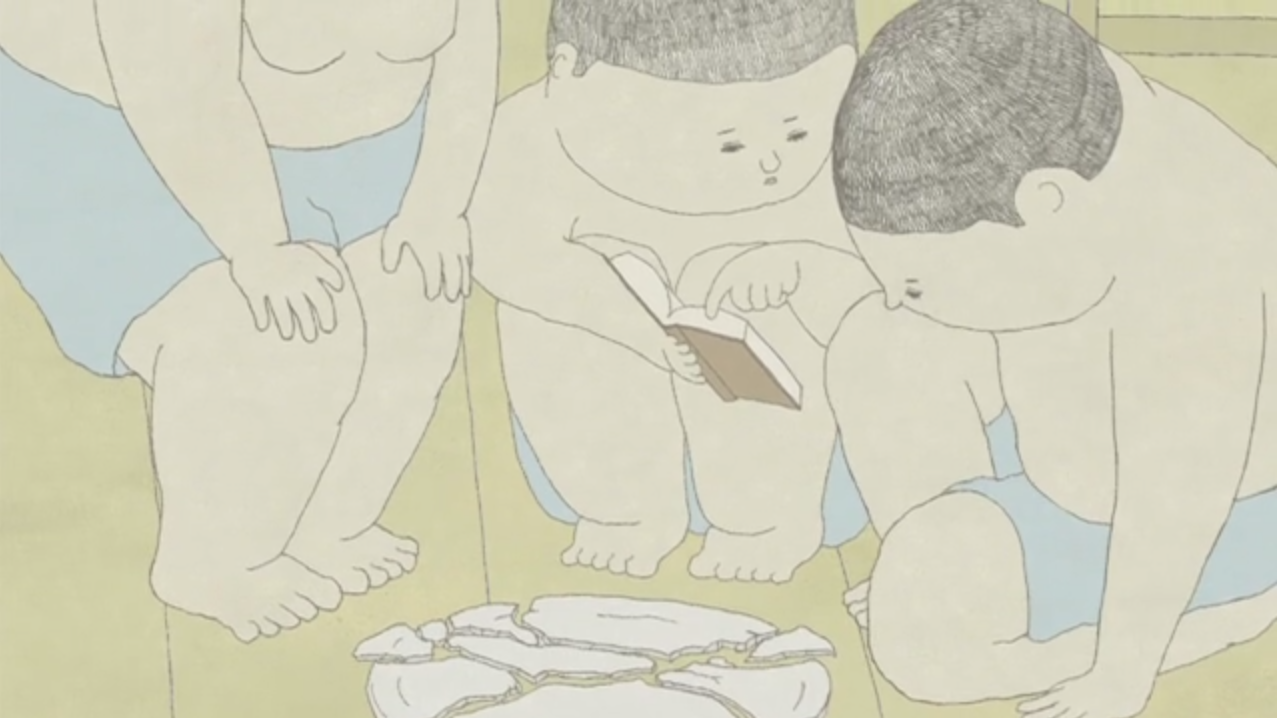
We try to enrich ourselves through prayer, faith and devotion to someone or something ‘other’. Similarly, we believe in the existence of ‘anomalies’, such as unknowable and uncontrollable monsters. But can such beliefs advance us?

LINKS

Interview with Atsushi Wada – http://www.animateprojects.org/interviews/interview_with_atsushi_wada

IMDB Profile – http://www.imdb.com/name/nm3514433/

Art of the Absurd: An Interview with Atsushi Wada – http://nishikataeiga.blogspot.co.uk/2010/11/art-of-absurd-interview-with-atsushi.html

CREDITS

A film by Atsushi Wada Colour design Misa Amako

Sound design Masumi Takino

Music Miki Sakurai

Voices Yoshimi Tajima and Luiz Kruszielski

Produced by Abigail Addison

Mastering by VET

An Animate Projects production for Channel 4

Carroll / Fletcher would like to thank Abigail Addison and Animate Projects for their collaboration in the programming of this season of films

The Museum of Loneliness and post-cinema

Thanks to Gareth Evans, I recently came across Chris Petit’s reflections on and responses to the digital revolution and its impact on the way we experience the world and art – the explosion of the image bank, fragmentation, flattening and ubiquity, memory, experience and attention, the rise of sampling, recycling and post-production.

“The Museum of Loneliness (MoL) was founded a couple of years ago as a non-institution dedicated to working in the gaps, and positioned at the opposite end of dot com. No website, no facebook, no twitter, MoL is essentially a parasite working through other bodies. It is not particularly lonely either, in case you were wondering. The loneliness refers to its founding observation that modern life’s primary relationship is no longer human but with the screen – actual and psychological – making everywhere connected and unconnected, lonely and not lonely at the same time.

When the digital revolution exploded the image bank, it placed us in a state of what could be called post-cinema. Cinema, like popular music, used to be something to be kept up with but everything has fragmented and flattened out, leaving it both more accessible than ever and at the same time – given the impossible, proliferating backlog – unknowable. Hence the fashion for specialisation and the growing prominence of the curator: those experts and brokers of taste, which remains the misguided be-all and end-all…”

The full article can be read here.

And there’s a related interview – We Are Analogue – with Chris and Rachel Bowles for The Skinny at the 2014 Glasgow Film Festival:

“The Skinny: What is post-cinema how does it relate to the Museum of Loneliness? How did the idea come about?

Chris Petit: With the technological revolution that’s been going on over the last 15 years, the whole image bank has exploded. We’ve moved into a different kind of way of thinking about visual images, it’s a kind of second stage, and there are two parallel movements. There is one that breaks images down into fragments like YouTube and then there are these marathon events from the art world where everything is made incredibly long, like Christian Marclay’s exhibition, The Clock, which was a 24 hour montage film set to real time. As far as the Museum of Loneliness is concerned, it’s kind of a conceit, it is not a real thing. It’s founded on the principle that today our primary relationship is with the screen, it’s not really with each other anymore, it’s with different kinds of screens; both the psychological screen and the real screen of the computer screen. Somewhere in all of that comes the idea of post-cinema.  The other phenomenon that is happening now is the progression to the next stage: the idea of cinema’s memory. It is how cinema is remembered. What certain writers have been pointing out for quite a long time is that you don’t remember films in the way that you see them, you only remember fragments. These fragments build up into what could be called cinema’s memory. So somewhere within that the concept of post-cinema lies. I would say it was, it is, more an idea than a theory…”

The full interview can be read here.

A fragment from a lecture Chris delivered as an introduction to his work Lee Harvey Oswald’s Last Dream at the 2014 Oberhausen Film Festival:

“This is not about that fashionable subject, death of cinema, but is about the ‘after’ of something, a shift which is probably too early to identify yet, other than by hairline cracks. I am curious to know exactly when cinema as I understood it ended. Because something has passed, not only in the obvious transitions from film to tape and from analogue to digital. There’s a more personal history…’


For Cultural Purposes Only

Sarah Wood, still from For Cultural Purposes Only (2009), image © Ruanne Abou-Rahme


Sarah Wood

28 August – 31 August

For Cultural Purposes Only

2009, 8’16”

Courtesy Animate Projects and Sarah Wood.


SYNOPSIS

In an age dominated by the moving image what would it feel like to never see an image of the place that you came from?

The Palestinian Film Archive contained over 100 films showing the daily life and struggle of the Palestinian people. It was lost in the Israeli siege of Beirut in 1982. Here interviewees describe from memory key moments from the history of Palestinian cinema. These scenes are drawn and animated. Where film survives, the artist’s impressions are corroborated.

“When you say to someone ‘you’re history’ it doesn’t mean that you’re part of it; it means that you’re obliterated. That’s what history means.” From For Cultural Purposes Only.


SARAH WOOD ON THE DOUBLE THINK AND THE IMPORTANCE OF THE TITLE

*Dazed Digital: Why ‘For Cultural Purposes Only’?
Sarah Wood: ‘For cultural purposes only, no commercial value’ is the phrase that is written on customs forms when films prints are sent internationally. The declaration is intended to speed a film’s journey through the customs process. Some time ago, I came across an article that the filmmaker Annemarie Jacir had written about her experience of curating a festival of Palestinian film in New York. In the article she talked about the practicalities of curating, and the difficulties of physically getting material across the world to screen in the US. Films sent from Palestine were simply going missing in transit. One film lost in the post might seem like a mistake but after a little detective work she realised films that she was certain had been sent from Palestine weren’t making it through Israeli customs. She realised that what singled the missing films out was their customs declaration. Instead of being something that facilitated movement, the simple statement ‘for cultural purposes only’ was being read and used as a means of gauging the content of the package and preventing their movement out of the country. I was very struck by this story, not only for the inhibition of the movement of art but also the added layer of meaning that the phrase had gathered. One of the striking things about the conflict between Israel and Palestine is the use of language by both sides to blur understanding and control the narrative of the conflict. I’m thinking, for instance, of the use by Israeli officialdom of ‘targeted killing’ to mean an assassination, or the use of ‘martyr’ by Palestinians to describe the same event. Both are euphemisms, both are used to control the effect of the act. Seeing the phrases ‘for cultural purposes only’ reinterpreted in this conflict made me question how hard it would be to create any art in the context of this double-think…”

The full interview can be read here.

Courtesy Dazed Digital.


SARAH WOOD DISCUSSING THE FILM IN THE GUARDIAN

“I am an artist who works with found footage, making films from other people’s films – an act of reclamation and reinterpretation. In the west, this footage is ubiquitous. It wouldn’t be hard for me, for instance, to find an image of the place I come from to show to a stranger; I just have to know where to look. So imagine what it would be like if every image of 1960s London, or of pre-war France, or Soviet Russia, vanished overnight. Imagine there was no footage of your home town. In an age dominated by the moving image, how would that vanishing act make you feel?…”

The full article can be read here.

Courtesy The Guardian.


SARAH WOOD’S 2009 UPDATE: DRAWING REALITY

I’m sitting indoors, looking out of the window at the whited-out world. A sudden snowfall has shocked Britain to a standstill. Everyone’s complaining. Trains don’t work, buses don’t work, things are going wrong. Commentators are scandalized on television as it’s revealed that Britain is running out of salt to grit the roads. More salt will have to be mined! Standstill!

Outside the snow world looks still and calm. Sound is muffled by the snow. Outside sounds like a thud. The language of TV panic seems entirely at odds with this stillness.

It’s only a few weeks ago since I watched Tzipi Livni announce on TV that Israel was to ‘change the reality’ of Gaza. As suddenly as this snowfall altered Britain, the lives and landscape of Gaza were altered by military action. Reality was ‘changed’. The snow has now nudged Gaza off the headlines. TV landscape has been whited out too.

The full update can be read here

Courtesy Animate Projects.


BIOGRAPHY

Sarah Wood has been working for the last ten years in film. Her latest film projects have all been an exploration into ideas of the archive using found footage. I Want To Be A Secretary won best film at the Halloween Film Festival 2007, The Book of Love (2008) tours with a live soundtrack performed by the Exploits of Elaine and most recently The Angel of History (2008) (a collaboration with Jersey Film Archive) played in the Jersey War Tunnels with live soundtrack performed by Zan Lyons, as part of the first Brancharge Film Festival. Sarah is currently in development for Swingin’ Dors a video piece about Diana Dors and the British studio system.


FILMOGRAPHY

The Angel Of History, 2008
The Book Of Love, 2008
I Want To Be A Secretary, 2006
Surrender, 2005
Manifesto For Love, 2003
Living Space, 2003


LINKS

Sarah Wood’s Website

Dazed Digital Interview 

Little White Lies interview

Sight & Sound article 

Animate interview

Animate – For Cultural Purposes Only film page 


FOR CULTURAL PURPOSES ONLY CREDITS

A film by Sarah Wood

Illustration – Woodrow Phoenix

Animation – Kate Anderson

Photography  -Ruanne Abou-Rahme

Cartography – Simon Deeves

Soundtrack – Basel Abbas

Editor  -Lucy Harris

Research – Kate Daniels

Camera – Campbell

Online Editor – Sue Giovanni

Sound Andy Coles

Extract from Children Nevertheless © Khadijeh Habashneh

Extract from Far From the Homeland © Kais Al-Zubaidi

Extract from Leaving Jerusalem by Railway (Louis Lumiere, 1897), Courtesy of the Prelinger Archive, (www.archive.org)

Extract from Screen Traveller: Damscus and Jerusalem (1926), Courtesy of the Prelinger Archive, (www.archive.org)

Text – Mustafa Abu Ali, Palestinian Cinema Group Manifesto, Edward Said

Title – Courtesy of Annemarie Jacir taken from her essay of the same name

Executive Producers Jacqui Davies & Gary Thomas

Thank you:
Mustafa Abu Ali, Abigail Addison, Sonia Bridge, Nick Denes, Nicky Haire, Bridget Hannigan, Shadia Nasralla, Idit Nathan, On Sight, Judy Price, Ali Smith

v

v

THANKS

v

Carroll / Fletcher would like to thank Abigail Addison and Animate Projects for their collaboration in the programming of this season of films