Carroll / Fletcher

Palestine Remembered

1 – 12 October 2014

Dominique Dubosc

Palestine Remembered

2004, 37’34”
274615257_640 (1)


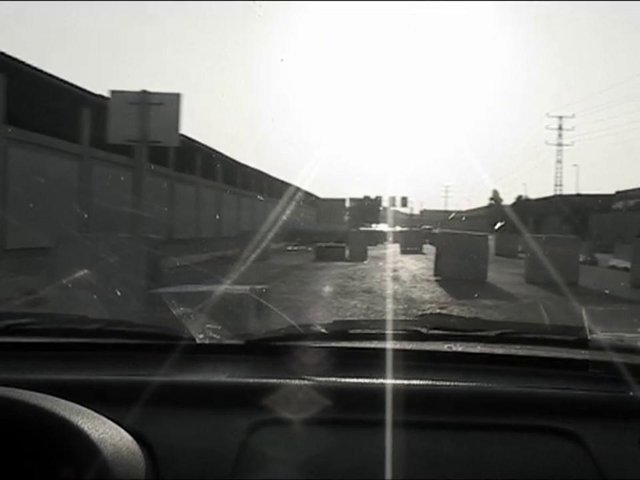
The season of films presented in collaboration with Animate Projects closes with Dominique Dubosc’s Palestine Remembered.  The film was included in Animate Projects exhibition in 2009 Drawn from Life (guest curated by writer and curator Stoffel Debuysere). The exhibition presented artists’ films that explore drawing, mapping and Palestine, including the work of artists Till Roeskens, Dominique Dubosc, and Sarah Wood (the Carroll / Fletcher onscreen season opened with Sarah’s film – For Cultural Purposes Only). An essay by Stoffel Debuysere accompanied the exhibition.


SYNOPSIS

In July 2002, the designer Maja Daniel was invited to Palestine by the Consulate of France in Jerusalem and the Palestinian Ministry of Culture, to revive a project drawing schools in Ramallah and Gaza. Dominique Dubosc decided to accompany him. Dominique’s project was not to account the ‘Maja mission’ (from the beginning doomed to failure because of the curfew imposed on major cities in the West Bank, and Israeli incursions ravaging Gaza), but to create a movie showing Dominique and Maja’s different perspectives. Throughout the spring of 2003, one day a week, Maja agreed to improvise under the eye of the camera, drawing images that evoke both Palestine and a wider world, filled with his usual bestiary. Dominique then spent several months with an editor to rework the images shot on the spot to give them a painterly quality, and added background music, to evoke a sense of memory.

.
.
PALESTINE – filmic reflections from Dominique
 .

Palestine Palestine (2002)


FILMOGRAPHY

Memoria desmemoriada / Paraguay Remembered (2014)

Occupied Territories (12 screens installation)

Curitiba Biennal 2013

Dreamers on 125th Street (2008)

The Listening Chamber (2005­ – 2007)

News in Three Lines (2001­ – 2008)

Palestine Remembered (2002­ – 2004)

First Prize Festival Traces de Vies (France)

Palestine Palestine (2001­- 2002)

Creativity Prize Festival Traces de Vies (France)

First Prize Festival of Sucre (Bolivia)

Celebrations (2000)

a play by Copi (1999)

Homosexuality or the Difficulty of Selfexpression (1998)

Duane MICHALS (1993) – Contact series.

Visiting Jonas MEKAS (1992)

Jean ROUCH, First Film: 1947 – 1991 (1947 ­- 1991)

The Letter that Was Never Written (1990)

LIVE series (ARTE)

The Filmmaker or Novel of a Childhood (1989)

The School of La Neuville (1986)

A Short History of French Unions (1984)

A Passage to India (1981)

Mumbai Film Festival

Memories of Workers in Besançon (1978-­ 1979)

LIP or The Sense of Working Together (1976)

Cannes Film Festival (Quinzaine des réalisateurs)

The LIP Struggle Continues (1974)

NO to Downsizing ! (1973)

How to Attain and Maintain Unity (1973)

The Penarroya File : The Two Faces of the Corporation (1972)

The Days of our Death (1970)

Manojhara – The Santa Isabel leper colony (1969)

Kuarahy Ohecha (1968)


LINKS

Artists Website here.


CREDITS

Director Dominique Dubosc
Drawings Daniel Maja
Editing Dominique Dubosc and Bernard Josse
Music JS Bach and Munir Bachir
Production Kinofilm
 

“IT SHOULDN’T BE CALLED COMPUTER ART IN THE FIRST PLACE!”

Manfred Mohr – in his own words

Whilst the 1973-74 16mm film Cubic Limit is an exquisite summary of Mohr’s practice, it was not until twenty years later that he fully incorporated moving image into his practice.  In 2000, Mohr introduced colour and animation to give fuller expression to the incredible richness of the multiple, complex variations of multi-dimensional cubes

“Since the beginning of my computer related work, the character of motion was always inherent, but I was not too eager to show a development of the signs in time. The visual processes were mostly presented in series, or so to speak in a step by step development where one can go visually forward and backward in his or her time to freely contemplate each sign. Each sign is an instant of the program…  Only around the year 2000, I realized that the complexity of my work rose to a point, that I could not communicate to the viewer this content in an easy visual way. I decided to render this development of signs (images) in a real time movement on flat screens to visualize this complexity in a specific and adequate way…  I think I succeeded, because the viewer suddenly could “feel” (through the movement from instant to instant) the complex structure even though he or she does not really understand it. The colors in these moving images are there to facilitate this process, and should only be seen as distinctions to show forms and relations. The colors are always chosen randomly by the program.”

Courtesy Bitforms Gallery, New York

Mohr’s moving-image pieces are not video works with a finite duration.  The images are generated in real-time from the algorithms programmed by Mohr, the digital image doesn’t run on a loop: it could go on for ever, never repeating itself.

“I like to show the screen with the moving images (calculated in real time), together with the computer standing on the floor like a partner in crime, as “one work”. My new work (2011), however, does not use a PC but a Mac Mini, which I built behind the screen, and is therefore not visible anymore.  I can accept this possibility too! … The screen could be seen as a modern canvas!”


It shouldn’t be called Computer Art in the first place,  There’s confusion between how something is produced and what you show.  Nobody says: ‘he’s a pencil artist’ because he makes only drawings.  I always laughed when people asked if it was art.  What else is it?  It’s what I do…  It’s either art and it’s interesting or it’s nothing.”

“One day in the sixties I read books by a German philosopher called Max Bense.  The second law of thermodynamics is that an order over time dissolves into a random nothing, into chaos.  Bense thought in art we should do it the other way around; we can start with chaos and go to order.”

“All my relations to aesthetical decisions always go back to musical thinking, either active in that I played a musical instrument or theoretical in that I see my art as visual music… I was very impressed by Anton Webern’s music from the 1920s where for the first time I realized that space, the pause, became as important to the musical construct as the sound itself. So there are these two poles, one and zero.”

“At the very early stages, people thought that maybe when you make a computer drawing you should also show the programme next to it or you should have all-sorts of explanations, but in the end that’s not the point because the visual result is the only thing which counts and it’s not really important how something was made.”

did i?

23 – 30 September 2014

Hiraki Sawa

did i? 

2011, 9’13”


141-640x360


SYNOPSIS

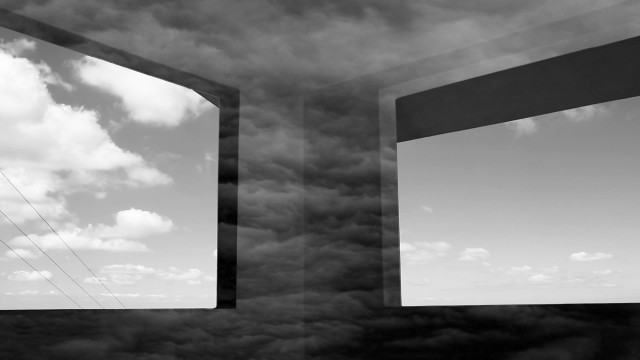
A boy closes his eyes for 25 minutes and wakes up with the world gone from behind his thoughts. His language slips and shifts, he tastes orange juice without knowing anymore to describe it as sour, he likes numbers but cannot put names to faces. His room is filled with a thousand records and many more. He sees the records, unable to listen. He can’t see the floor, has never seen the floor beneath them, wouldn’t recognise it if he met it in the street. He meets people in the street and his only option is to trust that they know him when they say they do. His records become opaque, circular slabs of the unknown and the unknowing. A fog of landscapes without contours, without borders, that can only be read by touching. To move forward he must step out, one foot then the other, and believe that he is indeed moving. His mind like an emptied lake, the sky welling upward and outward, unable to contain the depth of it all, the bottomless, fathomless wealth of the things he lost in his sleep.

Text by Dale Berning.


BIOGRAPHY

Hiraki Sawa’s video installations present intimate observations in transitory landscapes, familiar surroundings often inhabited by anoetic forms. Trees growing from a table, or a clock suddenly endowed with legs are natural interventions made by Sawa, yet extraordinary and unpredictable for the audience. His use of animation, sharp attention to lighting, and meticulously composed shots, are amalgamated into layered works. Sawa has the ability to manipulate his imagination into a tangible dimension that sits between the parallel languages of sculpture and film.

Hiraki Sawa (born 1977, Ishikawa, Japan) received his BFA from the University of East London and his MFA from the Slade School of Art at University College, London.  Sawa’s work has been the subject of solo exhibitions at Dundee Contemporary Arts, the Shiseido Gallery, Tokyo, Chisenhale Gallery, London, National Gallery of Victoria, Melbourne,  Hirshhorn Museum and Sculpture Garden, Washington DC, Hammer Museum, Los Angeles, Saint Louis Art Museum, Colby College Museum of Art, Waterville; Wexner Center for the Arts, Columbus, Hiroshima City Museum of Contemporary Art, and the Musée des Beaux-Arts et d’Archéologie et Musée du Temps de Besançon with Le Consortium, Dijon.

Full biography from Paraffin Gallery available here


FIGMENT

Figment is an ongoing project that encompasses the film did i? Figment is a collection of works that comprises of a group of increasingly surreal videos about the phenomenon of amnesia. The series takes its inspiration from, and is an ongoing means of processing, the sudden-onset and complete memory loss of one of the artist’s friends.  So far the project consists of three ambitious videos: did i?, sleeping machine and Lineament

Lineament is available to view here courtesy of James Cohan Gallery.


FILMOGRAPHY

Envelope, 2014

Lineament, 2012

Souvenir III, 2012

Sleeping Machine I, 2011

For Saya, 2011

Figment: did i?, 2011

Figment: Record, 2010

O, 2009

Small Metal Gods, 2009

Out of the Blue, 2008

Hidden Tree, 2007 Hako, 2007

Unseen Park, 2006

Trail, 2005

Eight Minutes, 2005

Going Places Sitting Down, 2004

Airliner, 2003

Elsewhere, 2003

Migration, 2003

Spotter, 2002

Dwelling, 2002


LINKS

Hiraki Sawa interview for Animate Projects

Hiraki Sawa interview at James Cohan Gallery

Hiraki Sawa: did i? by Coline Milliard


CREDITS

A film by Hiraki Sawa

With thanks to Rie Nakajima and Elliot Dodd


Carroll / Fletcher would like to thank Abigail Addison and Animate Projects for their collaboration in the programming of this season of films