Rotterdam Film Festival – a personal selection
The programme at The Mosaic Rooms on Cromwell Road caught my eye and reminded me of the developing body of work that critically engages with our use of drones in warfare – George Barber, James Bridle, Harun Farocki and Omer Fast spring to mind (see below for examples). Mosaic Rooms have an exhibition – Mouths At The Invisible Event – of David Birkin‘s work “centred around censorship, spectatorship and the legal and linguistic frameworks underpinning war”, and an related programme of films and lectures:
28 January, screening – Tonje Hessen Schei‘s documentary DRONE “looks at the CIA drone war. It follows people on both sides of the drone technology. The unique access to drone victims in Waziristan is juxtaposed to drone pilots who struggle to come to terms with the new warfare.”
Details and booking here.
5 February, panel discussion – Unmanned, reflecting on the growing use of armed drones in modern warfare. Participants to include Julian Stallabrass and Chris Woods.
Details and booking here.
11 February, screening – Harun Farocki‘s War At A Distance
Details and booking here.
Harun’s four-part series Serious Games (2009 – 2010) also provides a counter-point to War At A Distance and Omer Fast’s 5,000 Feet is the Best (see below).
A FEW MORE WORKS REFLECTING ON THE USE OF DRONES
Omer Fast‘s 5,000 Feet is the Best (2011) can be found in full here (courtesy of the artist and GB Agency).
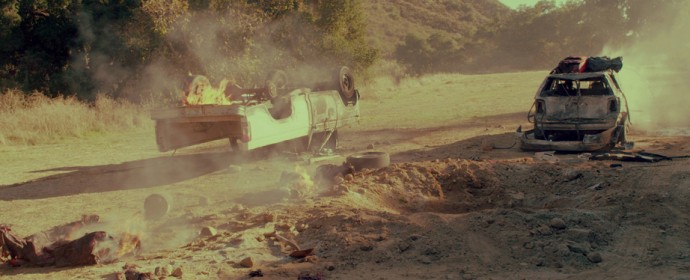
Still for 5,000 Feet is the Best (courtesy of the artist and GB Agency).
George Barber‘s Freestone Drone (2013)
Courtesy Waterside Contemporary.
Here‘s a link to the 2013 exhibition at Waterside Contemporary. Sukhdev Sandhu’s Sight and Sound review of the Waterside exhibition (link at the bottom of the Waterside webpage above) is interesting: “New conceptual associations – like playing on the meaning of drone (think ‘thankless labour’) – are overlaid with cinematic links to the French New Wave. The film draw on Georges Delerue’s richly emotional music for Godard’s Le Mepris, uses black-and-whit stills evocative of Marker’s La Jetee and borrows Last Year in Marienbad’s story line of a woman repeatedly telling a man that they’ve never me before. By the end, the drone-as-human conceit has stopped being absurd and has begun to feel weirdly melancholic, saturated with sadness.”
James Bridle‘s Dronestagram: The Drone’s Eye-view (2012 – ongoing).
“Wadi al Abu Jabara. Beit al Ahan. Jaar. Dhamar. Al-Saeed. Tappi. Bulandkhel. Hurmuz. Khaider khel.
These are the names of places. They are towns, villages, junctions and roads. They are the names of places where people live and work, where there are families and schools. They are the names of places in Afghanistan and Yemen, which are linked by one thing: they have each been the location of drone strikes in the past couple of months. (The latest was in the early hours of November 7th, the night of the US election.)
They are the names of places most of us will never see. We do not know these landscapes and we cannot visit them.
What can reach them are drones… [read more here]”
Follow the project on twitter here or on tumblr here or on instagram here.
James’ Drone Shadow series (2012 – ongoing) is an eerie reminder of what might be overhead right now…
Courtesy of the artist.
And then there’s the excellent Tim Wilcox curated exhibition – Sensory War – at Manchester Art Gallery to 22 February 2015 (details here).
SYNOPSIS
Jean Genet described the family as the most destructive cell.
Located somewhere between meditation and dream, Ecology is a film in three parts that fuses an exploration of narrative with Turner’s dedication to formal experimentation to look at the unsettling side of families. While on holiday at an eco-retreat in Majorca, three characters – mother, daughter and son – tell three different stories about the same violent incident. Composed as internal monologues narrated as voice-over, each sequence entraps us within the psyche of a character, reinventing a modernist literary sensibility within a cinematic language that exploits an innovative range of grains and gauges. Whilst referencing a debate on the ethics of the environment, Ecology’s real concern is ideas of psychic re-cycling, the debris that’s passed on and re-circulated amongst people; it takes the three themes of the environment, familial psychic structures and technology as critical sites of crisis and change and insists that we consider them together.
Shot on location in Spain and England on multiple formats including Super 8, stills, DV and mobile phones – technologies that live inside one another as they evolve – the imaging of the film mirrors the characters struggle for stability and consistency. The three parts of the film can be viewed in any order. The possibility of viewing the sequences in any order (there are six possible permutations and exhibitors determine which version they’ll screen – although onscreen is only presenting one version) confirms the circularity that is at work that denies causality to events or a hierarchy to the media. The stories, like the psyche, like media, incorporate others but also refer us on in an endless chain of suggestion. There is no conceivable resolution, rather we are part of an endless recurrence, a mode of transmission rather than comprehension.
Ecology has six permutations, this version – SHE / I / YOU – is only one of the ways in which this film can be viewed.
Read Janet Harbord’s article ‘The Fragile Relations of Ecology’ about the film here
There is also additional information about the film available on the Cornerhouse website here
BIO
Sarah Turner trained at St Martin’s School of Art and the Slade School of Fine Art. She is an artist, filmmaker, writer, curator and academic. Her feature films include Ecology, 97mins, 2007, Perestroika, 118mins, 2009, (currently featured in Tate Britain’s major survey: Assembly), and Perestroika:Reconstructed, conceived and executed as a gallery work (Carroll Fletcher Gallery, London, April/ May 2013). Turner’s short films include Overheated Symphony, UK, 10mins, orchestrated for Birds Eye View Film Festival 2008, Cut, 17 mins, 2001, was broadcast on Channel 4, and A Life in a Day with Helena Goldwater, 20 mins, 1996, and Sheller Shares Her Secret, 8 mins, 1994, both headlined Midnight Underground when they were also broadcast on Channel 4. Sarah has had feature scripts commissioned by the BFI, Film Four Lab and Zephyr Films. Amongst other curatorial projects, Turner produced (with Jon Thomson) the launch programme for Lux Cinema in 1997; Hygiene and Hysteria: The body desired and the body debased, a touring programme of artists’ film and video for Arts Council England and programmes for Tate and the National Film Theatre. Sarah is currently Reader in Fine Art and Director of Research in the School of Music and Fine Art, University of Kent.
PUBLIC HOUSE
Sarah’s new film, Public House, is currently in development with FLAMIN, more information here.
Public House fuses fact and fiction in a multi layered exploration of memory, community and social reinvention. Activated in response to the community takeover of the Ivy House pub, London, SE15, this feature length work for cinemas is a shape shifting genre hybrid that moves from observational document to minimalist opera. Interweaving testament, performance poetry and an innovative soundscape that fuses acousmatic composition and verbatim librettos, the film explores individual and cultural memory and its resonance in shaping social spaces…
More information available from the Public House website here
FILMOGRAPHY
perestroika:reconstructed, 178 mins, (2013)
This is Not a Pier: For Poetry Beyond Text, 12 mins, (2011)
Perestroika, 118 mins, (2009)
Overheated Symphony: For Birds Eye View Film Festival; 10 mins, (2008)
Ecology , 97 mins, (2007)
London Birds Can’t Fly, 11 mins, (2003)
CUT, 17 mins, (2001)
A Life in a Day with Helena Goldwater, 20 mins, (1996)
Sheller Shares her Secret, 8 mins, (1994)
A Tale Part Told, 4 mins, (1991)
One and the other time, 5 mins, (1990)
She Wanted Green Lawns, 4 mins, (1989)