Carroll / Fletcher

Half Life

Chris Oakley

Half Life

2008, 14’36”, HD video

10 March – 16 March 2015


half life


Half-life looks at the histories of Harwell, birthplace of the UK nuclear industry, and the development of fusion energy technology at the Culham facility in Oxfordshire. Produced with the cooperation of both these organisations, the film examines nuclear science research through a historical and cultural filter. Drawing on archive footage of the sites, alongside contemporary materials, the work takes structural clues from nuclear physics, exploring the heritage of nuclear energy from the roots of the technology that drove the industrial revolution. The relationship between nature, and our reliance on mineral energy resources, and the portrayal of the often-mundane realities of nuclear research seek to ‘normalise’ emotionally driven debates around the subject. With the recent widespread acceptance of the reality of climate change driven by carbon dioxide emissions, the work explores the realities and myths surrounding the nuclear sciences. Half-life was commissioned by the Arts Catalyst and SCAN.

http://www.chrisoakley.com/

Half-life

The average time needed for half the nuclei in a sample of a radioactive substance to undergo radioactive decay. The half-life of a substance does not equal half of its full duration of radioactivity. For example, if one starts with 100 grams of radium 229, whose half-life is 4 minutes, then after 4 minutes only 50 grams of radium will be left in the sample, after 8 minutes 25 grams will be left, after 12 minutes 12.5 grams will be left, and so on.
Source: The American Heritage® Science Dictionary


The Arts Catalyst

The Arts Catalyst is one of the UK’s most distinctive arts organisations, distinguished by ambitious art commissions and its unique take on art-science practice.  The organisation’s primary focus is commissioning new artists’ projects, presented in a range of museums, art galleries and other public spaces in the UK and internationally. In its 20 years, The Arts Catalyst has commissioned more than 120 artists’ projects, including major new works by Tomas Saraceno, Aleksandra Mir, Critical Art Ensemble, Jan Fabre, Yuri Leiderman, Stefan Gec, Otolith Group, Beatriz da Costa, Kira O’Reilly and Marko Peljhan, and has produced numerous exhibitions, events, performances and publications, collaborating with major arts, science and academic organisations.

The Arts Catalyst plays a leading role in the development of artists’ engagement with science, and critical discourse around this field. Through commissions, exhibitions and events, Arts Catalyst enables people to have distinctive, thought-provoking experiences that transcend traditional boundaries of art and science.

http://artscatalyst.org/

Nuclear Fission

Spontaneous or induced splitting of an atomic nucleus, usually with an associated release of energy.  The most common fissile nuclear fuels are uranium-235 (half-life 704 million years) and plutonium-239 (half-life 24,110 years).

Nuclear Fusion

The creation of a new nucleus by merging two lighter ones, with the release of energy.

Arts Catalyst Nuclear Culture Project

The Nuclear Culture Project is a curatorial exploration of nuclear culture, which began with considering the conceptual and cultural challenges of dismantling nuclear submarines in the UK, inviting artists to consider the aesthetic, conceptual, ethical and cultural concerns of nuclear submarines in conjunction with experts in the field. The project is bringing together scientists, engineers and community activists with artists and ethicists to develop new opportunities for creative practice investigating nuclear culture. Specific areas of enquiry include: the invisibility of the nuclear economy, the Fukushima Daiichi Nuclear Power Plant meltdown, geological waste storage, the Anthropocene, and nuclear humanities [more here].

Nuclear Culture website here.

Eva & Franco Mattes Plan C

“We made a rather adventurous trip to Chernobyl, Ukraine, site in 1986 of one of the most dramatic nuclear disasters ever…[more here].”


The Last Biscuit

Andrea Luka Zimmerman and Paul Hallam

The Last Biscuit

2009, 20’40”

27 February – 9 March 2015


The Last Biscuit (Paul Hallam and Andrea Luka Zimmerman, 2009, 20:40 min.) is a film essay on theatre, memory and desire and the ‘theatre’ of the city.  It formed part of a changing/developing performance piece Dirty Linen: an Evening with Paul Hallam, staged at various venues, including The Cochrane Theatre, London in 2006.

Screen Shot 2015-03-10 at 13.49.50 copy

An accompanying text by Paul Hallam

I wanted to look at the “theatre” of the city, the city as a set. It would partly draw on my book, The Book of Sodom, with Nottingham as my featured city, the nearest city to where I was born, the mining town, Mansfield. It would look back, from my then London flat (2005) to my adolescence in Nottinghamshire in the late 1960s and the early 1970s.

I did not and do not want to “direct” anything about my life; I prefer to keep a certain distance and hand it over to others. On this occasion, by chance, I found the perfect collaborator in college – the filmmaker, Andrea Luka Zimmerman. Together we decided that I would open up my archive of the times. I am, perhaps sadly, a hoarder. I have kept almost every scrap of paper handed to me, down to the flatmate notes on “remember to get a pint of milk.”

We would just open up some of the old cases and files of papers and magazines and photographs. I would talk. Andrea would go back to Mansfield with me to film. I might be asked for an idea for the film or an opinion on the footage, but essentially I would be a passive participant in the film-making process. As we filmed, over just one weekend, I found myself relaxed and wondering how we might incorporate my mother’s letters from the time. Would I read from then? We hoped my sister Christine might agree to read from them instead. With only a minor show of resistance Chris, entirely unprepared, agreed. It helped that she and Andrea got on so well. And this is one of the ways I hope the film achieves a kind of spontaneity.

It was, and is still, a film about theatre. But it is also a film about the blurred borders of autobiography and biography, about memory, collecting and death.  It is in part a reflection on adolescent sexuality, formed through a filter of “culture”. The ways in which watching and reading the works of others helps affirm a sexual identity.

I am not sure why we put my name first in the “A Film By …” credit, though it works alphabetically.  Such a credit always causes headaches for compilers of databases. I know that from the long experience of Nighthawks, a film by Ron Peck and Paul Hallam. It is a great pleasure for me that this film now appears on that film’s thirtieth anniversary DVD release by the British Film Institute.  Andrea photographed the film and edited it. I don’t think either of us much expected it to be released; it was a kind of notebook. When the DVD possibility, the possibility of its being an “extra” came up, Andrea re-edited it for this, its final version.

The making and proposed screening of The Last Biscuit coincided with a difficult time for me, a mystery illness, what was labeled “a neurological episode” by the National Hospital for Neurology and Neurosurgery. Walking to teach an evening class, I lost a few hours of time; I did not know where I was, but some of it felt like heaven. It transpired I was still in King’s Cross, well I suppose it is my kind of heaven.

A strange and worrying time then. Perhaps the right time to reflect on the past, and to use a few of those old cases of papers.

Thankfully the mystery looks finally to be resolved, by a doctor here in Istanbul, in 2009.

To clear up a mystery credit. A guest appearance in the film is made by Andrea’s dog, Radio. Everyone watching the film assumes he is my dog. He looks so comfortable. He was there on the shoot; it was that kind of film.  Sadly Radio died of a rare illness in 2008.

The music? Until recently I had always thought that “I Will Take You Home, Kathleen” or “I’ll Take You Home Again, Kathleen” was a very old, traditional and anonymous song. The Internet recently informed me that whatever the Irish tourist sites may say, the song had a writer. Thomas Westendorf, a teacher in Illinois, wrote it in 1875 as a song for his wife, Jeanie. She was visiting her home town, Ogdensburg, New York at the time. It was a great hit. Many great singers have recorded this song, Elvis and Johnny Cash to name but two, and almost every Irish star.

We thought to include a medley of the versions, but the rights issue would make that impossible. At the last minute, for this release, Andrea asked a friend, the country singer Christine Cynn, to record the song. I was in Istanbul, where I now live, and the deadline for its inclusion on the film was up.

Christine’s version was “better than Elvis”, Andrea assured me, and I have to agree.

A woman singing the song to a woman, a tribute, a kind of offering to my mother, Kathleen. My Kathleen was Irish, but she was given away, shortly after her birth, by her Irish parents who did not want a child to an English couple who did. I still have the hand-written note that is all that records the transaction.

I hope such chance elements, some of them sad, also give the film a quality of something “fresh and green.”

Paul Hallam
Istanbul, February, 2009

Real Estates: A project by Fugitive Images

Fugitive Images are Andrea Luka Zimmerman and David Roberts, a ‘collaborative cultural activist producing agency, with a particular interest in, and commitment to, the social organisation of urban space’ – www.fugitiveimages.org.uk. Real Estates is a six week project coordinated by Fugitive Images at PEER in London, featuring work by, amongst others, Fugitive Images, Focus E15 Mothers, Tom Hunter, Bekki Perriman, Jeremy Till, Andre Anderson, John Smith and DIG Collective.  Further details can be found here.

“The project marks the end of a seven-year series of collaborative works with our neighbours of the Haggerston Estate.  Our work came from within the community, with whom we cultivated other spaces to gather, share and campaign before the estate was demolished in 2014.  Our neighbourhoods and communities are facing even greater threats from new developments and policies that separate and stratify us.  But there are also many that have resisted these forces…” Fugitive Images.  For more information and to subscribe to updates go to www.real-estates.info.


Helen Carmel Benigson: Interview and Performance

Screen Shot 2015-02-17 at 11.02.58

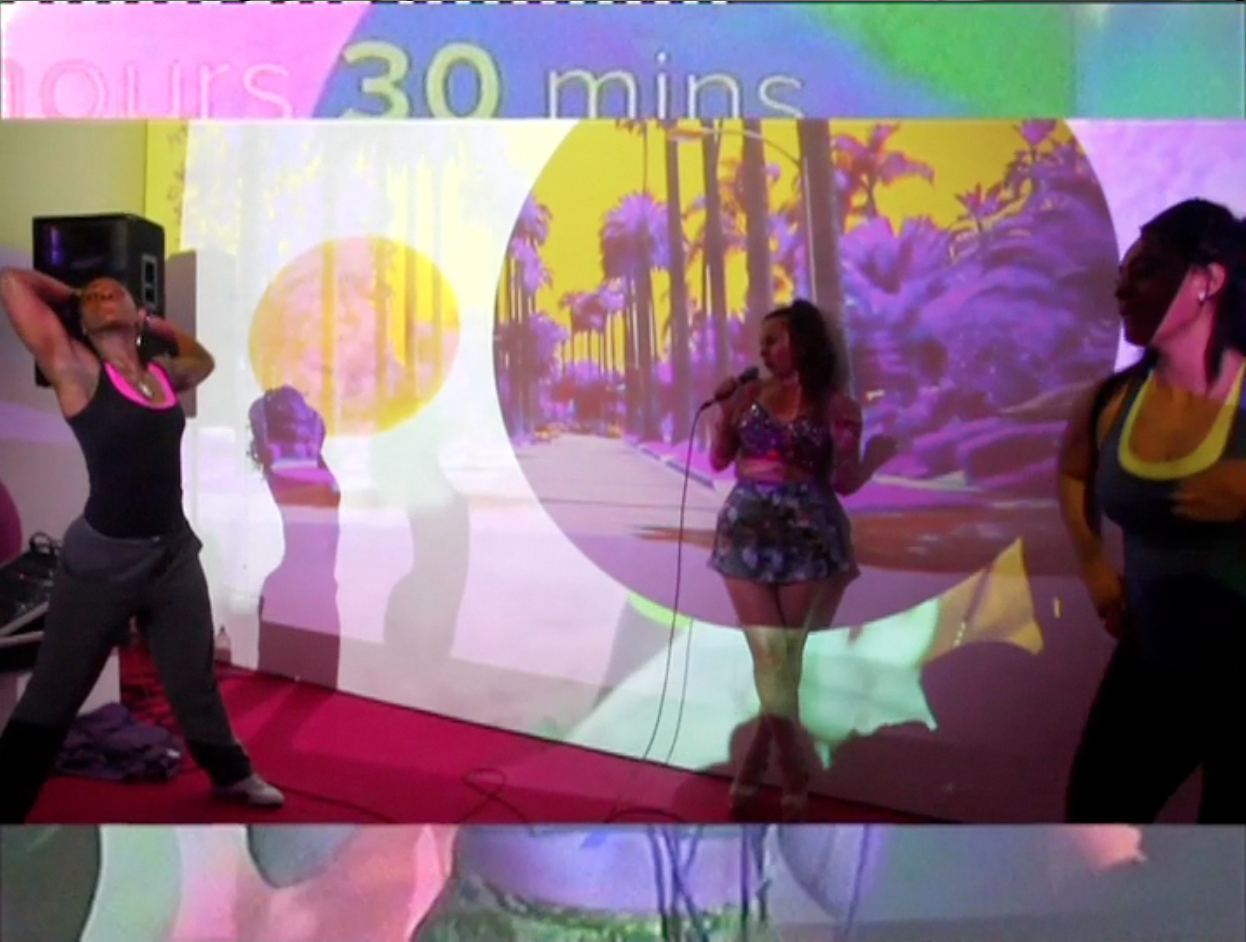
Helen Carmel Benigson, Stressful, Anxious, Insomnia, Fat, 2015, 6’12”
Helen Carmel Benigson’s performance Stressful, Anxious, Insomnia, Fat was filmed on the opening night of her exhibition Anxious, Stressful, Insomnia Fat at Carroll / Fletcher.


INTERVIEW: HELEN CARMEL BENIGSON

Interview by Philomena Epps. This Q&A originally appeared on Riposte.


Helen Carmel Benigson’s current exhibition Anxious, Stressful, Insomnia, Fat at Carroll/Fletcher is a lurid and dizzying experience. The room is saturated in a hypnotic, almost pixelated, light. The installation and video work explores how technology, when gendered, can cause a dematerialisation of the body. This particular show was inspired by the artist’s download of a ‘period and ovulation’ tracker, and the impact of monitoring one’s body through digital means. The animated environment emphasises a negotiation between identity, sexuality and cyberspace. As the show enters its final week, Philomena Epps spoke to Benigson to find out a little more.


PE: Could you talk in more detail about the title of your current exhibition: anxious, stressful, insomnia, fat – and how these words feed into the work?

HCB: I am interested in the presentation of the visceral tensions between performance, body and brain in online and offline spaces. The title comes from my own incessant anxiety and also inspired by the app ‘Glow’, a daily body-monitoring device which I downloaded and used while preparing for the exhibition.

PE: How do you make use of the conflict between issues of reality and emotions, and new developments in technology, like coding and bodymapping.

HCB: I find the overlapping of virtual and real space really exciting and this excitement becomes a material I play with within the work. Bodymapping, profiling, hyper technology and imagined territories are all constantly reworked, remodelled and then broken down.

PE: There seems to be a fascination with the removal or dematerialisation of the body through this technology? What is it about fantasy avatars, online identities or digitised gaming characters that appeals to you?

HCB: It’s about charting a time / space momentum and disrupting it as much as I can. I am interested in negative space or rather what happens around, underneath or on top of our computer screens as much as inside them. I flirt with the idea of multiple avatars or identities and think that my work often encourages multiples, repeating and procreating as much as possible.

PE: Is this replicated by the use of actors and dancers in performance pieces, or your creation of an alter ego – Princess Belsize Dollar? Are you deliberately trying to erase your status as an author?

HCB: Yes – the avatars or multiples appear as versions of myself in performances, and in the videos, and in Princess Belsize Dollar. However, I am not interested in erasing the status of the author, but rather extending an idea of profile or identity by presenting it in compounding versions.

PE: How do these types of performances, often site specific or taking place during one-off occasions, explore issues of temporality?

HCB: I explore ideas around the “instant” – I have a very short attention span and would never want other people to be bored when watching my work – I like the idea of moving quickly – get in, get out, move on.

PE: Your live performance at Carroll/Fletcher includes the presence of fake tan beauticians and female body builders – what interested you about these women?

HCB: These women are all experts in their field and this is inspirational and powerful. I include producers more than I include consumers and I ask them to collaborate with me in order to highlight contemporary strength in different forms. I think of these women as being versions of myself – so they become characters within a narrative. They have to perform a certain role when they become part of work – it is a scripted process although collaborative.

PE: The installation seemed to exemplify a commoditisation or stereotype of women. Alongside the video, there were more visceral displays of the female body: gynaecological ephemera, a paddling pool and a baby pink running machine. Where do you feel that digital and the physical can meet?

HCB: I think they meet in real life at every juncture. I am constantly on my phone, documenting the real – sending pictures of my body across the world, looking up medical symptoms online, inputting personal data into an app – this crudeness is problematic as well as seductive.

PE: Do you think we can ever craft a truly feminist online space?

HCB: I think it already exists in Instagram.


LINKS

Anxious, Stressful, Insomnia Fat exhibition at Carroll / Fletcher

Helen Carmel Benigson’s Website 

.

• The recording of the performance can still be viewed on our main website here