Carroll / Fletcher

Odds & Ends VI – “It’s time we made a start…”

The Discovery Award – a chance to view and vote

The LOOP video art festival and art fair have established the Discovery Award “to support and recognize the recent production of videos and films by international artists through a free open call”.  The exhibition featuring the finalist projects will be included in the program of LOOP.  There’s an online video channel screening the films selected for the second stage of the competition that enables the audience to vote until 18 May for the ten works to be included in the exhibition.  The online channel can be viewed here.

Adrian Melis’ Surplus Production Line (2014)

Linea de producción por excedente exploring the shifting politics of labour within the framework of neo-liberalism, in which employees and job-seekers are forced into harsh competition with each other and alienating them from their personal feelings. Melis started a private company in Amsterdam…[read more here].”

Courtesy of Adrian’s vimeo site here (thanks to the Discovery Award for drawing the film to our attention).

http://adrianmelisobras.blogspot.co.uk/

Harun Farocki ‘On The Documentary’

We documentarians often make Direct Cinema films. We look for events that occur as if they had been staged for a film. At the same time, we have to prove that we have found something and recorded it without writing or staging it. We might montage a sentence without the first words, or film a door half open—preferably not due to constraint, but to calculation.” Harun Farocki, read more here.

Thanks to e-flux and Trafic.

JJ Charlesworth on Why Art World Hypocrisy Stars at the 56th Venice Biennale

A polemic worth reading and discussing.

“What the Biennale doesn’t want to investigate is the mystery of its own creation. Why should it? Who really needs this vast moot for an increasingly homogenous and international style of slightly-political, issues-based art? Not the visiting public, for sure–we’ll look at anything, but we’re not the ones making it happen. No, who really needs it is the new global class of cultural entrepreneurs for which art has become a truly international opportunity, as the emerging economic regions seek to assert themselves on the world stage through the vehicle of the new global art culture. But however political these curators and artists think themselves, the art itself changes absolutely nothing. The Chinese still need oil, the European Union still shuts the door on immigrants, Libyans still drown in ships sinking in sight of the coast of Italy–little more than subject matter for yet more self-regarding political art.” J J Charlesworth, read more here.

Thanks to ArtNet.

A Few Post-UK Elections reflections from Marx

“Where it has come to power the bourgeoisie has obliterated all relations that were feudal, patriarchal, idyllic.  It has pitilessly severed the motley bonds of feudalism that joined men to their natural superiors, and has left intact no other bond between one man and another than naked self-interest, unfeeling ‘hard cash’.  It has drowned the ecstasies of religious fervour, of zealous chivalry, of philistine sentiment in the icy waters of egoistic calculation.  It has resolved personal worth into exchange value, and in place of countless attested and hard-won freedoms it has established a single freedom – conscienceless free trade.  In a word, for exploitation cloaked by religious and political illusions, it has substituted unashamed, direct, brutal exploitation.” Marx and Engels, Manifesto of the Communist Party.
“Philosophers have only interpreted the world in different ways, the point is to change it.” Marx, Early Political Writings.
 .

And from Simon Critchley – “It is time we made a start”

“No revolution is going to be generated out of systemic or structural laws.  We are on our own and what we do we have to do for ourselves.  Politics requires subjective invention, imagination and endurance, not to mention tenacity and cunning.  No ontology or eschatological philosophy of history is going to it for us.  Working at an interstitial distance from the state a distance that I have tried to describe as democratic, we need to construct political subjectivities that are not arbitrary or relativistic, but which are articulations of an ethical demand whose scope is universal and whose evidence is faced in a concrete situtation.  This is dirty, detailed, local, practical and largely unthrilling work.  It is time we made a start.”  Simon Critchley, Infinitely Demanding – Ethics of Commitment, Politics of Resistance, p.132.

Karen Mirza, Brad Butler’s Everything for Everyone and Nothing for Us (2014)

Everything for Everyone and Nothing for Us is set in a TV studio, where a protester-in-training listens to audio extracts from a political speech by Margaret Thatcher. Having absorbed the sounds, the protester uses movement to exorcise Thatcher’s voice, retraining the body to resist capitalism.” Brad Butler.

Courtesy of Karen and Brad’s vimeo site here (thanks to the Discovery Award for drawing the film to our attention).

http://www.mirza-butler.net/


Eyes On The Ground

Cristina Picchi

Eyes On The Ground

2012, 3’22”, HD, 16:9

7 May – 18 May 2015

cp

.Synopsis 

ITN Productions, which made the original Sri Lanka’s Killing Fields documentary, asked graduate film students to make a short film based on the original documentary.  Eyes On The Ground was selected to air on 4OD – Channel 4 On Demand – and was the most watched video in November 2012.

“Channel 4’s documentary Sri Lanka’s Killing Fields: War Crimes Unpunished (2012) begins with a warning: the film contains shocking images. And it really does. When asked to edit a video using the film’s footage I felt overwhelmed: everything seemed so important yet, when decontextualised from the original narrative, so horrific and unnecessarily graphic. I then decided to take a different approach. Eyes On The Ground is a simple video documenting five people watching Sri Lanka’s Killing Fields for the first time. It deals with human emotions and with the processes of acknowledgement – a disturbing but necessary process that everyone can undertake by simply watching a film, a first small step towards the possibility of some sort of justice.”

Commissioned by ITN Productions for Channel 4, courtesy of the Artist.

Sri Lanka’s Killing Fields

On 17 May 2009 the Liberation Tigers of Tamil Eelam finally declared defeat in the twenty-seven year civil war in Sri Lanka.  Following the end of the war, the Sri Lankan government claimed Sri Lanka as the first country in the modern world to eradicate terrorism on its own soil.  In April 2011, the UN says both sides in the civil war committed atrocities against civilians and calls for an international investigation into possible war crimes.  The Sri Lankan government says the report is biased.  In March 2012, UN Human Rights Council adopts a resolution urging Sri Lanka to investigate war crimes allegedly committed by Government forces during the final phase of the decades-long conflict with the Liberation Tigers of Tamil Eelam.  Sri Lanka says the move usurps its sovereignty.  In March 2013, UN Human Rights Council passes highly critical resolution urging Sri Lanka to conduct an independent and credible investigation into alleged war crimes.  In August 2014, President Mahinda Rajapaksa says a UN team tasked with investigating allegations of war crimes during the civil war will not be allowed to enter Sri Lanka.

It Never Happened

Edited from footage taken from ‘Sri Lanka’s Killing Fields: War Crimes Unpunished’, It Never Happened is a more direct, traditional response to the documentary and was conceived as a companion piece to be set against the more oblique approach Eyes On The Ground.

Screen Shot 2015-05-12 at 15.08.23

2012, 4′

Commissioned by ITN Productions for Channel 4, courtesy of the Artist.

Channel 4’s comprehensive investigation of Sri Lanka’s brutal civil war and analysis of alleged crimes against humanity can be found here and the documentary Sri Lanka’s Killing Fields: War Crimes Unpunished can be viewed on 4OD here.

Zima

A portrait of a season – a journey through North Russia and Siberia, through the feelings and thoughts of the people who have to cope with one of the world’s harshest climates; a reality where the boundary between life and death is so thin that is sometimes almost non-existent, where civilization constantly both fights and embraces nature and its timeless rules and rites. In these remote places, people, animals and nature itself become elements of a millennial yet unpredictable script, in which physical and mental endurance play an important role as much as chance does, where life and death constantly embrace each other. A reflection on fate, adaptation and the immutable cycles of existence.

Zima was created within the Cinetrain project travelling from Moscow to Lake Baikal on the Trans-Siberian Railway in mid-winter 2013.  Zima was exhibited in videoanale.15 (Cristina’s videonale.15 page can be found here) and is currently screening on the film festival circuit (where it has numerous awards – see below).  Consequently, we are only screening a trailer (kindly produced by Cristina specifically for Carroll / Fletcher Onscreen):


Upcoming Screenings and Exhibitions

Keep the Dream Alive! 29th – 31st of May, Metro Kinokulturhaus, Vienna, as part of VIS -Vienna Independent Shorts 2015

Impossible Landscapes (videoinstallation), Asifakeil, MuseumsQuartier, Vienna, from 3rd of June 2015

Bio

Cristina Picchi is an award winning Italian filmmaker, writer and visual artist based in London.  As a director she has directed and edited the short documentaries Zima (2013), Eyes On The Ground (2012), Under Your Skin (2011) and The Disassociated (2011); her films have been screened in festivals and galleries worldwide, winning prizes in festivals such as Locarno, Clermont-Ferrand and Thessaloniki. In 2013 she was nominated for Best Short Film at the European Film Awards.  Cristina holds a degree and an MA in European Literature from the University of Pisa and and a master’s degree in Screen Documentary from Goldsmiths University.  She is currently working on her first feature film.

www.cristinapicchi.com

Filmography 

2015 Champ des possibles (experimental documentary, CAN, about 15 minutes – currently in post production)

2013 Cinetrain: Russian Winter (RUS, 90 min.) with the episode Zima

2013 Zima (experimental documentary, 11”30”’, RUS)

2012 Eyes On the Ground (experimental documentary, UK, 3 min.)

2012 It Never Happened (experimental documentary, UK, 4 min.)

2011 Under Your Skin (experimental documentary, UK, 8 min.)

2011 Il Disassociato – The Disassociated (documentary, ITA, 33 min.)

Awards for Zima

March 2015: Best International Short Film at Sguardi Altrove Film Festival, Italy

November 2014: Special Mention of the Jury, 22nd Acipelago Film Festival, Italy

October 2014: Audience award for the “Made In Russia” selection of Shnit International Film Festival

September 2014: Best International Short Film, Short Shorts, Mexico

August 2014: Jury Award, Concorto Film Festival, Italy

July 2014: Best score, San Giò Verona Video Festival, Italy

June 2014: Special Mention of the Jury for Cinematography, DokuMA, Croatia

May 2014: Emidio Greco Award for best emerging Italian director (with Zima) from the European Festival of Lecce and CNC – Italian National Centre of Short Film.

Prix Du Public at Visions Du Réel, Nyon for the feature film Cinetrain: Russian Winter

March 2014: WWF Award at Thessaloniki Documentary Film Festival, Nomination for Best Cinematography at Byron Bay Film Festival, Honourable Mention at Oslo Screen Festival.

February 2014: Special Mention of the Jury, Clermont Ferrand Short Film Festival for Zima.

August 2013: Zima wins the Pardino d’Argento Swiss Life, Pardi di Domani International Competition and Locarno short film nominee for the European Film Awards – Pianifica Prize, 66° Locarno Film Festival.

Film Credits – Zima

Written, directed and edited by Cristina Picchi
Produced by Mirumir Studio
Producers Tanya Petrik & Guillaume Protsenko
Cinematographer Saulius Lukoševičius
Sound Director Henri D’Armancourt
Music by Shoefiti
Production Manager Katerina Okhonko
Production Assistants Alina Lobzina and Alexandra Marchenko.
With the financial support of the Ministry of the Russian Federation.
This movie was produced during the Cinetrain: Russian Winter Project, Russia, 2013 (details here)


XENOS

Mahdi Fleifel

XENOS

2014 12′ 06″

28 April – 6 May 2015


Screen Shot 2015-04-20 at 11.47.32


videonale.15: Can you describe your intention for doing art in one sentence?

Mahdi Fleifel: To make sense of life.

Synopsis

Xenos (Greek: ξένος, xénos) stranger, enemy, alien

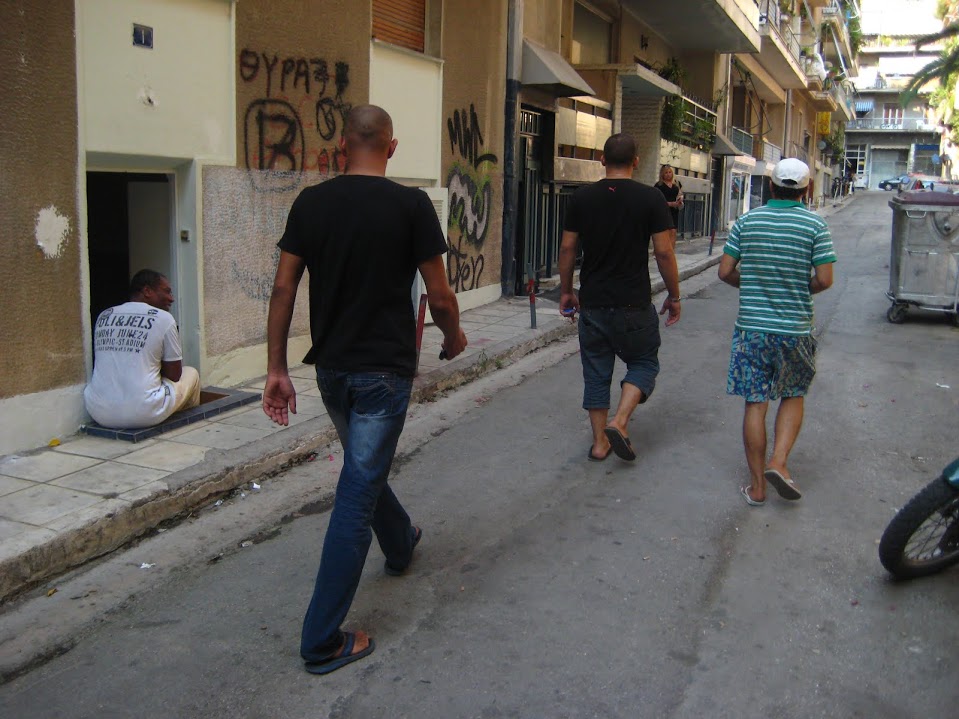
In 2010, Abu Eyad and other young Palestinian men from the Ain el-Helweh refugee camp in Lebanon travelled with smugglers through Syria and Turkey into Greece. Like so many other migrants, they came looking for a way into Europe but found themselves trapped in a country undergoing economic, political, and social collapse. Xenos is a short documentary blending footage shot on visits to Athens in 2011 with phone conversations recorded during Abu Eyad’s time there. It tells of his day-to-day struggle for survival and enduring sense of exile in a land of hope that has become a nightmare.

Xenos follows on from A World Not Ours (2012), in which the director depicted Abu Eyad’s life in the Ain el-Helweh refugee camp.

 Interview with Mahdi Fleifel – “God is not an estate agent”

“Can you say something about the discrimination of Palestinian refugees in Lebanon?

MF: There are 72 jobs they are not allowed to practice. They can’t be doctors, lawyers or government employees. Neither the Christians nor the Shiites in Lebanon wanted them to become citizens. This way they keep a large Sunni population out of the game. So the Lebanese say they’ll help them preserve their right to return to their homeland by not making them citizens so they don’t assimilate and forget about it.

In one scene you show your visit to Israel, even to Yad Vashem. How did you feel there?

MF: It was very strange. I was fortunate enough to go with my Danish high school class. We were hosted by an Israeli high school class so I didn’t have to deal with the nightmare of the Israeli checkpoints because I didn’t visit the West bank or Gaza. I was young then when I visited this place that throughout my childhood I was told was my home and where my grandparents came from. Yet I felt like a guest, an outsider who has been welcomed by others to his own home. It’s a very weird feeling. I’m not sure I understand it to this day.

Did you find any remains from the village Saffourieh, which your family left in 1948

MF: The only “archeological leftovers” was some ruin with a fence around where my grandfather used to keep his sheep… [read more here]”

Courtesy Igal Avidan and Qantara© Qantara.de
Links to more interviews can be found at the bottom of the page.

Biography

Mahdi Fleifel is a Palestinian filmmaker and visual artist based in London. He was born in Dubai, raised in the Ain El-Helweh refugee camp in Lebanon and later in the suburbs of Elsinore, Denmark. He graduated from the British National Film and Television School in 2009. His recently completed feature documentary, A World Not Ours, is currently touring the festival circuit and has already picked up multiple awards. His next feature, Men In The Sun is based on the themes and characters encountered while making Xenos, and is currently being developed as part of the New Danish Screen scheme.

Filmography

2013 Men In The Sun (feature film in development) – writer/director

2013 Xenos (12 min. documentary) – writer/director/photographer

2012 Visit Palestine (video installation for Koh-i-noor Gallery in Copenhagen)

2012 A World Not Ours (93 min. feature doc) – writer/director/photographer

2009 Four Weeks (17 min. fiction) – writer/director

2008 Arafat & I (15 min. fiction) – writer/director/actor

2007 The Writer (7 min. fiction) – writer/director/actor

2006 Harrisons Monday’s Arms (music promo) – writer/director

2004 Hamoudi & Emil (23 min. fiction) – writer/director/producer

2003 Shadi In The Beautiful Well (12 min. fiction) – writer/director/producer

Xenos Credits 

Director / Photographer: Mahdi Fleifel

Producer: Patrick Campbell

Editor: Michael Aaglund

Sound Designer: Gunnar Oskarsson

Digital Colourist: Aurora Shannon

Motion Graphics Designer: Damien Bent

Featuring: Abu Eyad, Nizar, El-Yes, Mukhtar, Abu El-Hob, El-Khal, Abed M


XENOS Still 2 - On The Road


Links

http://v15.videonale.org/en/artists/mahdi-fleifel/

http://www.nakbafilmworks.com/

Huffington Post interview here.

Doha Film Institute interview here.

Abu Dhabi Film Festival interview here.