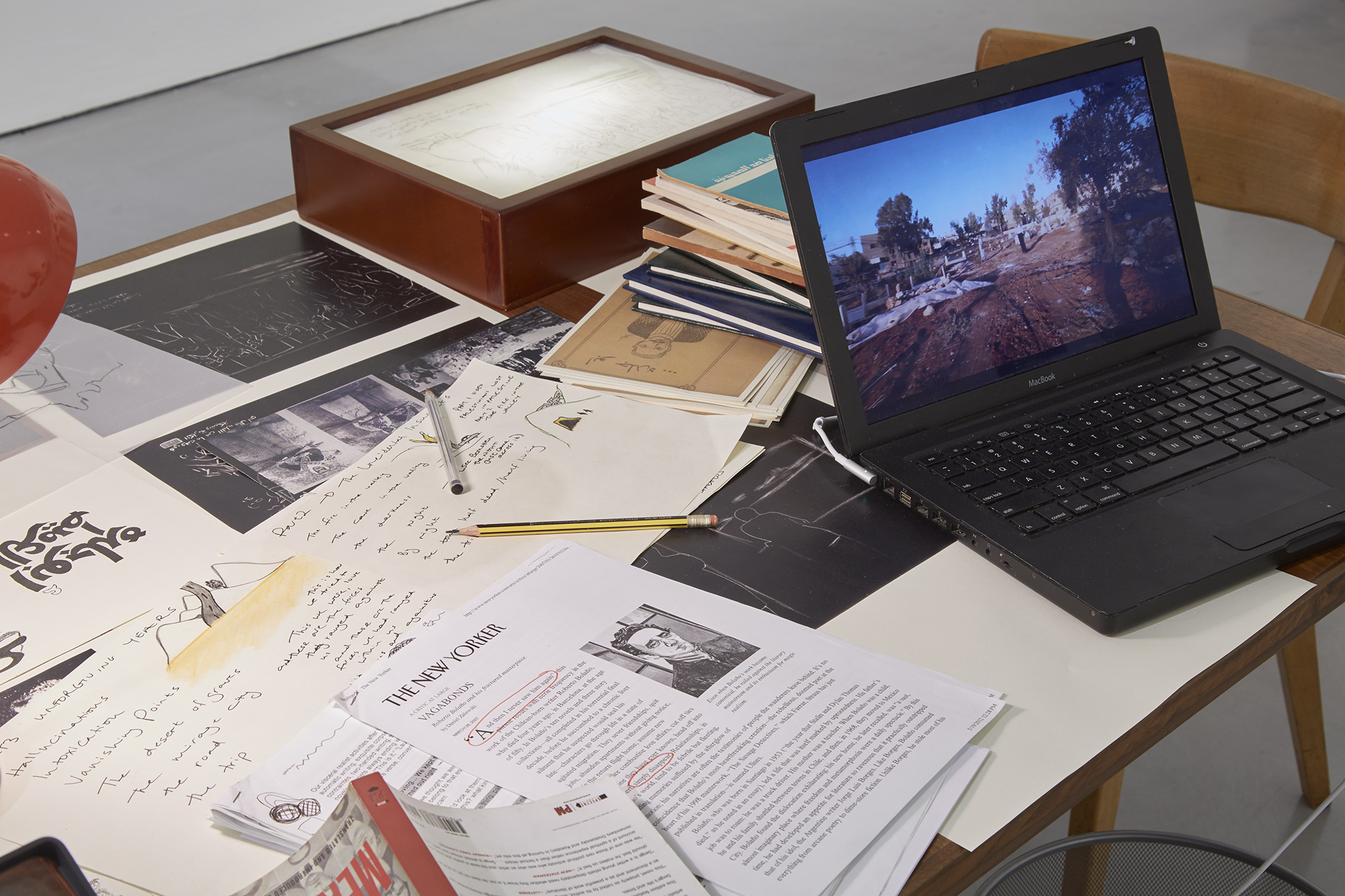
Carroll / Fletcher

One Thing Leads To Another

Chris Marker, Stopover In Dubai, (2011)

“[Chris Marker’s] late short video Stopover in Dubai is the most minimal effective gesture: it’s the film produced by the Dubai State Security service, of found CCTV footage tracking the assassins on their way to kill Mahmoud al-Mabhouh in his hotel room. All Marker has done is change the soundtrack, adding the first three movements of Henryk Górecki’s ‘String Quartet No. 3’: the dark adagio as the team assembles, drifting in and out of shopping centres; the profound gloom of the second movement, as the circle inexorably closes and the doomed man goes to his hotel room under the watchful eye of the surveillance group; and the escalating frenzy of the allegro as the work is done and the killers scatter.” From Chris Marker’s obituary in Radical Philosophy November/December 2012.

Emily Jacir Europa at Whitechapel Gallery

“Winner of a Golden Lion at the 2007 Venice Biennale, Material for a film (2004–ongoing) is a large-scale, immersive installation based on the life of Palestinian writer Wael Zuaiter who was assassinated near his home in Rome by Israeli Mossad agents in 1972. Jacir reimagines chapters of Zuaiter’s life through materials unearthed by the artist including family photographs, correspondence and documents relating to his death.” From the catalogue accompanying Emily Jacir’s solo exhibition at Whitechapel Gallery, London.
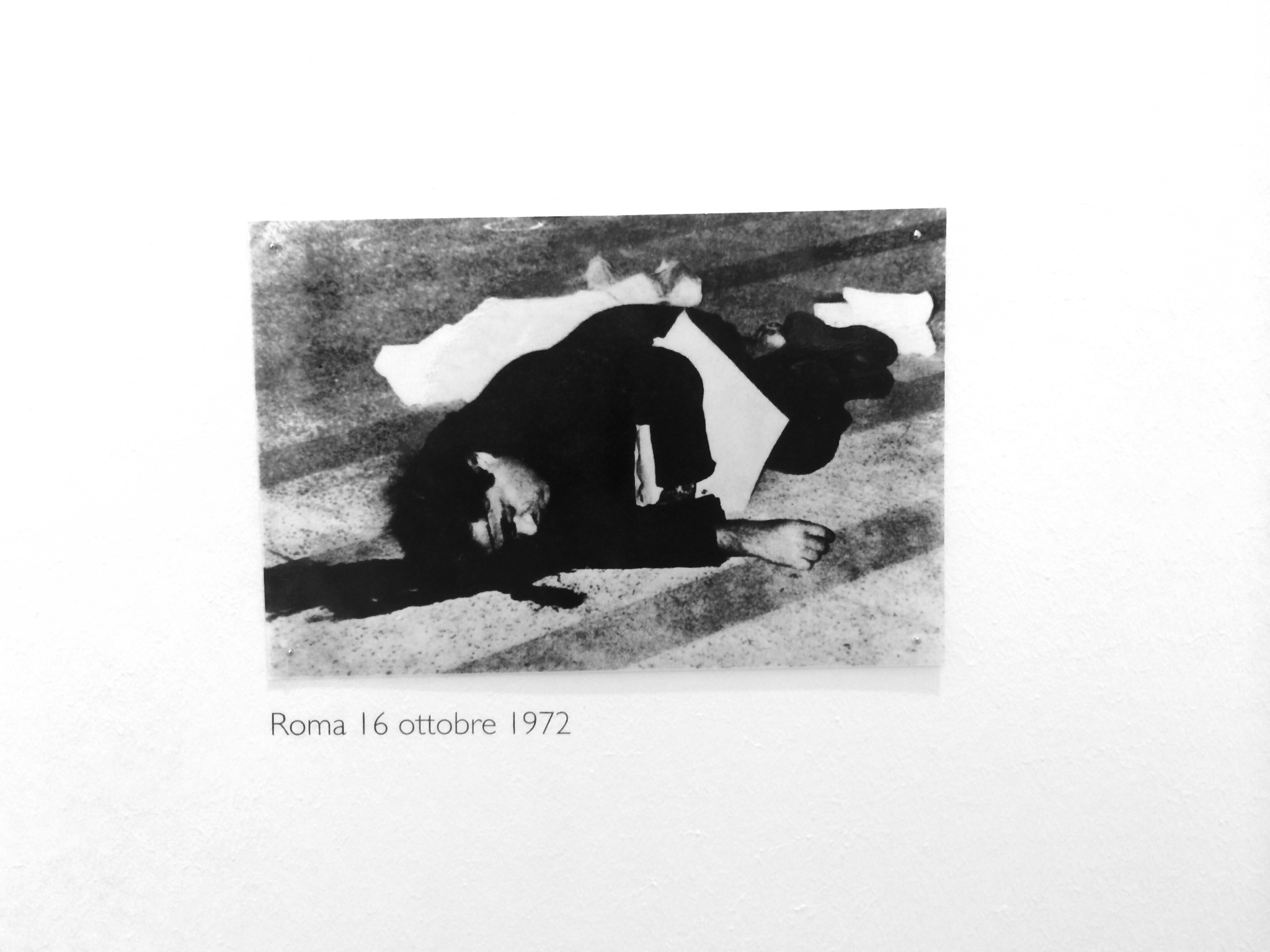
EmilyJacirPhoto“Wael Zwaiter / وائل زعيتر‎ ( 2 January 1934 – 16 October 1972) was a Palestinian translator assassinated as the first target of Israel’s Operation Wrath of God campaign following the 1972 massacre at the Munich Olympics. Israel considered Zwaiter a terrorist for his role in the Black September Group, while his supporters argue that he was “never conclusively linked” with Black September or the Munich massacre and was killed in retribution…[more here]” Courtesy of Wikipedia.

Eric Baudelaire, The Anabasis of May and Fusako Shigenobu, Masao Adachi and 27 years without images, (2011)

Trailer for Eric Baudelaire‘s film The Anabasis of May and Fusako Shigenobu, Masao Adachi and 27 Years without Images (2011)

“Who are May and Fusako Shigenobu? Fusako — leader of an extremist left-wing faction, the Japanese Red Army, involved in a number of terrorist operations — has been in hiding in Beirut for almost 30 years. May, her daughter, born in Lebanon, only discovered Japan at the age of twenty-seven, after her mother’s arrest in 2000. And Masao Adachi? A screenwriter and radical activist filmmaker, committed to armed struggle and the Palestinian cause, was also underground in Lebanon for several decades before being sent back to his native country. In his years as a film director, he had been one of the instigators of a ‘theory of landscape’ — fukeiron: through filming landscapes, Adachi sought to reveal the structures of oppression that underpin and perpetuate the political system. Anabasis? The name given, since Xenophon, to wandering, circuitous homeward journeys.

“It is this complicated, dark, and always suspenseful story that Eric Baudelaire — an artist renowned for using photography as a means of questioning the staging of reality — chose to bring forth using the documentary format. Filmed on Super 8 mm, and in the manner of fukeiron, contemporary panoramas of Tokyo and Beirut are blended in with archival footage, TV clips and film excerpts as backdrop for May and Adachi’s voices and memories. They speak of everyday life, of being a little girl in hiding, of exile, politics and cinema, and their fascinating overlap. All of which adds up not so much to an enquiry as a fragmented anamnesis.” Jean-Pierre Rehm (from the FID Marseille catalog).

The film is accompanied by a fascinating publication that’s available for free here from ISSUU (courtesy of Eric).

Jumana Manna – A magical substance flows into me (2015)

JM-WEB-04Courtesy Chisenhale and Jumana Manna

Jumana’s wonderful, inspiring, important new film forms the centrepiece of her first UK solo exhibition at Chisenhale, London.  The exhibition guide includes an Katie Guggenheim, Exhibitions and Events curator at Chisenhale, interviewing Jumana.

“I chose not to emphasise borders, in terms of what is Palestinian territory and what is Israel given that Lachmann’s radio programme took place before the partition of Palestine. I thought of Lachmann’s programme as radio waves spilling out across a territory, defining a certain polity, and participating in shaping the territory. In a sense, when making the film, I physically follow those waves. I follow the path of Lachmann’s research, performing the radio
waves as I travel to the different parts of the country bringing the recordings on my smart phone to where these groups live – even more segregated today than before. In this way, the structure of the work expresses both the loss of that political space –historical Palestine – but also my effort to retrieve it. This labor, and the traversal of various borders are not to idealise the period of the British Mandate, but rather to provide a space from which another Palestine can be imagined. It is part of my interest in going beyond the logic of segregation and separation. This paradigm of partition, the two-state solution that is still the prevalent one for Israel/Palestine is, I believe, no longer realistic or appropriate. It neutralises history by underestimating the pre-1948 realities, and is dysfunctional in the present conditions of the occupation. This is a big discussion, but essentially, given the increasing intertwinements – even if they are asymmetrical and devastating – resulting from the colonial expansion of
Israeli settlements in the West Bank, it is becoming increasingly impossible to imagine two separated states. Part of the decision to ignore borders in the film is also part of my interest in a long-term one-state, bi-national solution. Moreover, Israel is the only recognised state in the world that doesn’t have borders, so why would I adhere to the ones it imposes?” Jumana Manna.

The interview can be downloaded from the Chisenhale website here.

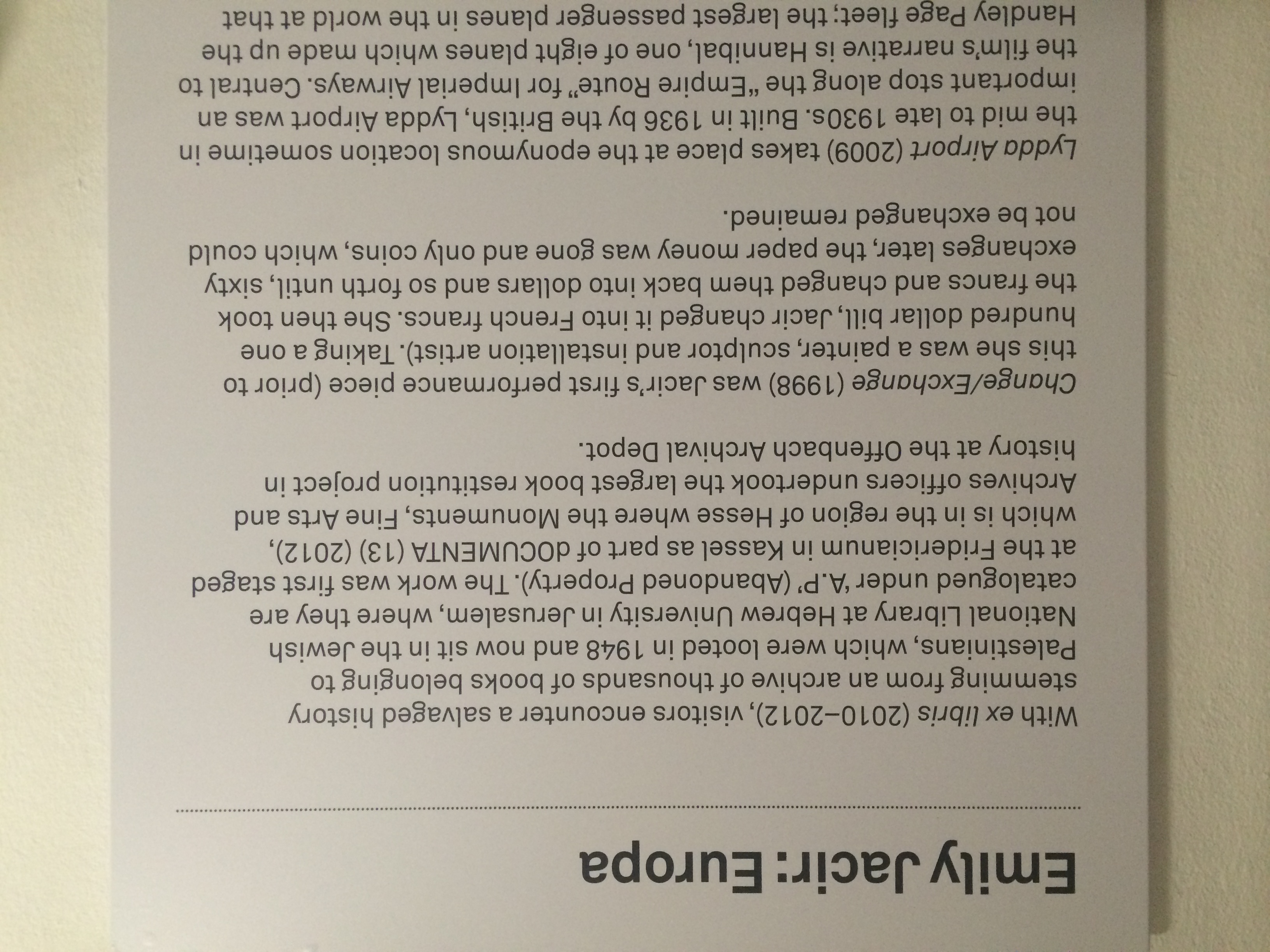
On your way back from, or on your way to, Chisenhale don’t forget to visit Emily Jacir’s exhibition at Whitechapel Gallery:
photo

Unforgiving Years: The Incidental Insurgents, Part 2

Basel Abbas and Ruanne Abou-Rahme

Unforgiving Years: The Incidental Insurgents, Part 2

2014, 6′ 30″

5 October 2015 – 10 November 2015


To accompany the exhibition of Unforgiving Years: The Incidental Insurgents, Part 2 in the downstairs space at 56 – 57 Eastcastle Street (25 September – 24 October) and at the Artissima art fair in Turin, Italy (5 November to 8 November), Carroll / Fletcher Onscreen is showing the film that links to the installation.


Screen Shot 2015-10-02 at 13.18.24


The Incidental Insurgents

We are believing and dis-believing
We are in the midst of the not yet material
or perhaps the already determined
inhabiting a time of radical potentiality and its collapse
In search of a new language
in need of this
always on the verge
always becoming and yet…

The Incidental Insurgents is mapped out as a three part multi-layered narrative, with chapters completing and complicating each other, and unfolding the ‘story’ of a contemporary search for a new ‘political’ language and imaginary. Multiple texts and fragments, largely the writings of Victor Serge and Roberto Bolano, alongside manifestos, memoirs, testimonies, and text written by the artists, are sampled and re-pieced together to form an altogether new script. As the project unfolds and the search continues, new threads emerge that take us into expected and unexpected places, deadly serious and deadly playful all at once. Contributing to a growing density of material, where the figure of the incidental insurgent, part bandit, rebel, part vagabond, artist, returns and resurges in many forms and characters. Recast into a convoluted script of sampled text, images, objects and sounds.

The Part about The Bandits, begins with four seemingly disparate coordinates, the early anarchist life of Victor Serge and his contemporary anarchist-bandits in 1910’s Paris; Abu Jildeh and Arameet and their bandit gang in volved in a rebellion against the British in 1930’s Palestine, the artist as the quintessential bandit in Roberto Bolaño’s novel The Savage Detectives set in 70’s Mexico, and the artists themselves in present day Palestine. Weaving the first part of the story by looking at the resonance between the inspiring, bizarre and sometimes tragic stories of these diverse bandits, the outsider rebel par excellence, often rewritten as mere criminals (or naively romanticized as wayward figures) and excluded from the narrative of revolutionary struggle. Ironically these figures most clearly articulate the incompleteness and inadequacies in existing oppositional movements political language and imaginary. Often desperately searching for a language able to give form to their impulse for more radical forms of action.

Unforgiving Years, the second part of the story, traces the metamorphosis of these incidental figures (Serge, Bolaño, the artist themselves) or the resonance of their final gestures years after they have been killed (Bonnot Gang, Abu Jilda), following the figures or their echo to strange places and obscure positions. Arriving at a vanguard political publishing house in 1970’s Jerusalem. Perhaps it is here that the trace of Abu Jildeh, dead then for 40 years, returns.


Screen Shot 2015-10-02 at 13.19.38


Where the first part of the story expresses the impulse for more radical forms of action, the characters urgent need to overcome their unbearable living conditions, the second part partially looks at what happens when these gestures are unfulfilled, for those who are not killed, somehow left behind. At the same time, it unfolds a recurrent impulse to refuse the seeming ‘permanence’ of a capitalist-colonial present, that though defeated at multiple moments continues to resurge and return. Unforgiving Years is about things lost and others glimpsed in the wreckage, about what can be conjured into being from the ashes.   A victory in defeat. A provocation to rethink the seemingly un-imaginable.

“Then they would reshuffle the pieces of this story and talk to me about those shadowy figures, those occasional brothers and sisters -in-arms, the ghosts populating their vast freedom, their vast desolation”.

In the last part of the search When The Fall of the Dictionary Leaves all words lying in the street (2015), obsession gives way to hallucination. Times, places and characters recede leaving only the impulse towards that unfullfiled desire for a radically different way of being.   We are somehow in the folds and density of moments, recaptured, retrieved and made anew, embodying all the characters and situations we have lived vicariously. That is to say embodying all times.


Screen Shot 2015-10-02 at 13.22.44


“This was a daydream, Vaneigem cheerfully admitted – but “daydreaming subverts the world”. When this free field was finally opened by the noise of the exploding syntax, when the fall of the dictionary left all words lying in the streets, when men and women rushed to pick them up and make pictures out of them, such day dreams would find themselves empowered turning into catalysts for new passions, new acts, new events: situations, made to be lived by their creators a whole new way of being in the world”

A multi-channel sound piece is the main pulse of the final chapter, with 4 screens playing intermittently and creating a choreography of movement and pauses, synchronization and disjuncture. Elusive traces, objects and material from this hallucinatory search appear in the space between the screen, as though they are another code we are meant to decipher, a broken syntax to be reassembled, an unfinished map. The beginning of a daydream, one that could subvert the world as the Situationist would have said.

The Incidental Insurgents is meant as an investigation into the possibilities for the future rather then the past, where a convoluted story situated in multiple times starts to emerge. Initiating an obsessive search to figure out how we, like the incidental figures before us, find ourselves inhabiting a moment full of radical potential and disillusionment. Searching for what we cannot yet see but feel is possible.


Screen Shot 2015-10-02 at 13.26.25


Bio

Basel Abbas (b. 1983, Nicosia, Cyprus) and Ruanne Abou-Rahme (b. 1983, Boston, US) live and work between Ramallah and New York. Solo exhibitions include ICA, Philadelphia, USA (2015); OCA, Oslo, Norway (2015); AKW, Cologne, Germany (2014); and New Art Exchange, Nottingham, UK (2011). Selected group exhibitions include the 12th Sharjah Biennial, Sharjah, UAE (Recipients of the Sharjah Biennial Prize, 2015); 10th Gwangju Biennale, Gwangju, Korea (2014) and 31st Sao Paulo Biennial, Sao Paulo, Brazil (2014). The Incidental Insurgents, Part 2: Unforgiving Years will also be shown in Present Future at Artissima 2015. The Incidental Insurgents, Part 3: When the fall of the dictionary leaves all words lying in the streets will be shown at Kunsthalle Wien as part of the exhibition Political Populism, opening 7 November


Basel Abbas and Ruanne Abou-Rahme (1)

Basel Abbas and Ruanne Abou-Rahme (12)

Basel Abbas and Ruanne Abou-Rahme (11)


GESPIELIN

Ayla Pierrot Arendt,

GESPIELIN

2014, 22’00”

16 June – 22 June 2015


Gespielin_APArendt_3


Synopsis

“GESPIELIN reveals the editor´s choreography of the available material from an 18 day working phase with two hired dancers. Her interests and desires, her way of creating relations of relevance, effect how you see the dancers and their play. To document is to show interest in something. To edit means to choose what is interesting. But the depicted constitutes the gaze of the voyeur as well as it reaffirms the labour and existence of the performer. The camera was looking for the rare event, exotic features, extreme situations; a real moment and the beauty in it. The women performed conscious of the gaze of the camera; they fictionalized themselves as the Other that looks back in order to inscribe themselves in history as subjects of consciousness. Their time is retrievable, public and relevant. Otherness can be performed and explored constructively when it understands itself and video has become its tool.” Ayla Pierrot Arendt.


Bio

Born 1987 in Munich, DE.

Visual Art studies in the USA and at the Academy of Fine Arts in Vienna, AT.  Master of Choreography and Performance at the Applied Theatre Department in Giessen, DE.

Ayla Pierrot Arendt works choreographically, thinking and staging in order to contribute to a historical time with perspectives of critical and feminist nature. Her interests lie in the immediate access to an event and experience, and their translation to effect. She interrogates perceptions and the scope and potential of actions, not to write fiction but to crystallize reality. She looks for ways of participation.

Her main media are video and installation, as these are time and experience-based. Painting and drawing allow visualizing the processes of overwriting and deleting more effectively that is why she likes to use them as screens for reflection and projection. The gap between practice and product is part of her examination of the Inter-esse as the performative moment between trigger and (re)action.

Exhibition and festival participation: Videonale, Kunstmuseum Bonn, DE; Lichter Art Award, Frankfurt, DE (Finalist); 27.Dresdner Filmfest, DE; European Media Art Festival Osnabrück, DE; antimatter Media Art Festival, Victoria, BC, Canada; Biennale des Bewegten Bildes, Frankfurt, DE.


GESPIELIN at videonale.15

“The earth revolved, so that we came close to one another, it revolved about itself and in us till it finally brought us together in this dream. I lose myself in the person whom I see. I am a permeable membrane. I soak up her beauty. She shines. She sparkles. She does not move. She just stands there. In all her loveliness. Absolutely immaculate. Like an angel. I now see the world only in

Courtesy Xhesika Hoxha and videonale.15, read the full text here.


Credits

Performance: Oksana Griaznova, Merel Roozen

Camera: Maren Wiese

Dramaturgy: Marion Siefert

Sound: Fullruhm, Don Dyzette, Rahel Pötsch

Support: Hessische Filmförderung

© Ayla Pierrot Arendt, 2014.


Contact

ayla.pierrot.arendt@gmail.com

dddocumentary.com