Carroll / Fletcher

The Yes Men Fix The World

The Yes Men Fix The World

The Yes Men

1’35’39”


The Yes Men

For the last 20 years, notorious activists the Yes Men have staged outrageous and hilarious hoaxes to draw international attention to the practices of corporations and governments and to the effects of these practices on individuals, communities and the environment. Armed with nothing but quick wits and thrift-store suits, these iconoclastic revolutionaries impersonate corporate officials to bluff their way into business events and government functions to expose the dangers of neo-liberal capitalism.

The Yes Men’s interventions at business events and government functions, on the internet, television, and in the streets form the basis of three feature-length documentaries, The Yes Men (2003), The Yes Men Fix The World (2009) and The Yes Men Are Revolting (2014).

The Yes Men’s work has been shown in the Whitney Biennial, the Venice Biennale, Ars Electronica, and many other art exhibitions. The Yes Men are the recipients of numerous awards, including Creative Time’s Leonore Annenberg Prize for Art and Social Change, Grierson Documentary Award, Berlinale Panorama Audience Award, the United Nations Association Film Festival Grand Jury Award, Best Documentary Award at HBO Comedy Arts Festival, and the Audience Award at the International Documentary Festival Amsterdam. They are the authors of several books, articles, and they lecture internationally on art and social change.  These days, they are focusing all their energy on a nonprofit, the Yes Lab, and the Action Switchboard, an online platform for generating real-life direct actions in the service of social movements.

In their own words

Who are you? The Yes Men are a group who use any means necessary to agree their way into the fortified compounds of commerce, and then smuggle out the stories of their undercover escapades to provide a public glimpse at the behind-the-scenes world of big business. The stories are often both shocking and hilarious. They have been called “the Jonathan Swift of the Jackass generation” by author Naomi Klein. The Yes Men have impersonated World Trade Organization, Dow Chemical Corporation, and Bush administration spokesmen on TV and at business conferences around the world. They do this (a) in order to demonstrate some of the mechanisms that keep bad people and ideas in power, and (b) because it’s absurdly fun. Their main goal is to focus attention on the dangers of economic policies that place the rights of capital before the needs of people and the environment. Right now they’re focused on passing carbon emissions laws in the USA.

That sucked. How about another one? We’re The Yes Men, Andy Bichlbaum and Mike Bonanno. Two guys who couldn’t hold down a job until they became representatives of Exxon, Halliburton, Dow Chemical, and the U.S. federal government. As the Yes Men, they use humor, truth and lunacy to bring media attention to the crimes of their unwilling employers. Their second film, The Yes Men Fix the World, won the audience award at this year’s Berlin Film Festival, the Grierson Award for Most Entertaining Documentary, and went on to become a smash box-office sensation, only just barely surpassed by Avatar. We introduce ourselves in this film, The Yes Men, directed by other people, but starring us.

Q & A continues here.

A Few Yes Men Resources

Yes Lab – “a series of brainstorms and trainings to help activist groups carry out media-getting creative actions, focused on their own campaign goals. It’s a way for social justice organizations to take advantage of all that we Yes Men have learned – not only about our own ways of doing things, but those we’ve come in contact with over the decade and a half we’ve been doing this sort of thing.”  Find out more here.

Action Switchboard – The Yes Men’s online platform where you can propose an action idea, receive Yes Lab feedback, and solicit help (and funding) from others.

Destructables – “a DIY site for projects of protest and creative dissent. Share what you know…” [here].

Electronic Frontier Foundation – “the leading nonprofit organization defending civil liberties in the digital world. Founded in 1990, EFF champions user privacy, free expression, and innovation through impact litigation, policy analysis, grassroots activism, and technology development.” Find out more here.

Beyond Talk – “was initially created for the sole purpose of environmental activism, especially with regards to promoting affirmative political action against climate change. Despite signs of greater consensus and urgency among major global economies of the need to tackle this problem, climate change remains a challenging global issue that requires great political will and concerted effort on the part of world leaders.”  Find out more here.

Beautiful Trouble – “a book, web toolbox and international network of artist-activist trainers whose mission is to make grassroots movements more creative and more effective. A collaborative effort by 70 artist-activists-strategists and 10+ leading creative campaign organizations including the YesMen/YesLab, Ruckus Society, Other 98% and others.” Find out more here.

How David Beats Goliath, Malcolm Gladwell, The New Yorker, 2009

Actipedia – an open-access, community-generated wiki to document, share, and inspire Creative Activism.

A Glossary

Cease and Desist Letter – “A cease and desist letter, also known as “infringement letter” or “demand letter,” is a document sent to an individual or business to halt purportedly unlawful activity (“cease”) and not take it up again later (“desist”). The letter may warn that if the recipient by deadlines set in the letter does not cease and desist specified conduct, or take certain actions, that party may be sued.” Source Wikipedia.

Jude Finisterra – Dow Chemical spokesperson who announced on BBC World News Dow’s acceptance of responsibility for the Bhopal disaster.

Gilda – gilded skelton used by The Yes Men in 2005 presentation to demonstrate Dow Chemical’s new risk management system.

Hank Hardy Unruh – name used by The Yes Men when speaking at the WTO conference in Finland in 2001.

THE-YES-MEN-speaker-nextgengallery-Andy-Bichlbaum-with-Golden-Phallus-suit-eviltwinbookingdotcom-400x400_c

Identity Correction – editing corporate press releases and presentations to make them sane.

McLibel Trial – go here.

SLAPP Suit – “A strategic lawsuit against public participation (SLAPP) is a lawsuit that is intended to censor, intimidate, and silence critics by burdening them with the cost of a legal defense until they abandon their criticism or opposition.” Source Wikipedia.

Yes Man – “a person of unquestioning obedience. Stooge, flunkey, flunky, follower – a person who accepts the leadership of another. Pushover.” Source The Yes Men.

images

One final question

What’s your favourite action, among the ones that you’ve done?  “You know the last scene in Charlie Chaplin’s The Great Dictator? Mistaken for Hitler at the border of Austria, the Jewish barber makes a speech to the soldiers waiting to start the Anschluss:

Greed has poisoned men’s souls; has barricaded the world with hate; has goose-stepped us into misery and bloodshed… Even now my voice is reaching millions… victims of a system that makes men torture and imprison people… Soldiers! Don’t give yourselves to brutes, men who despise you and enslave you… Soldiers! Don’t fight for slavery, fight for liberty.

The soldiers cheer wildly and call off the Anschluss. That’s our favorite. Hunh? What do you mean, we didn’t do that?” The Yes Men.


BRANDON

“In 1993 Brandon Teena (born Teena Renae Brandon), a young transgender person living as a man, was raped and murdered in Nebraska when it was discovered that “he” was anatomically a woman. Shu Lea Cheang‘s 1998 work Brandon is a multifaceted web project that uses the nonlinear and participatory nature of the Internet as a means to explore and illuminate Brandon Teena’s tragic story. From the opening image of morphing gender signifiers, Cheang propels the viewer into a probing investigation of human sexuality. It is an inquiry that utilizes hyperlinked images of a disembodied human form, once-live chat rooms on the subject of crime and punishment, and graphic moving images in order to illuminate the wide-reaching effect of Brandon’s life and death…[read more here]” Guggenheim’s website.


bigdollClick on BRANDON to go to the website.  Enjoy the road-trip, take a detour to Theatrum Anatomicum where there’s a case study and virtual trial session related to Brandon.

Two events were staged at the Theatrum Anatomicum in The Waag, Amsterdam: ‘DIGI GENDER SOCIAL BODY: Under the knife, Under the spell of anaesthesia’, a performance and installation, and ‘Would the jurors please stand up? Crime and punishment as Net Spectacle’, a netcast round-table. Both events were broadcast on the video wall of the Guggenheim Museum and presented on the World Wide Web.

TAinstallation1

Click on BRANDON to go to the website.  BRANDON was commissioned in 1998 by the Solomon R. Guggenheim Museum and produced in association with the Waag Society for Old and New Media, The Institute on the Arts and Civic Dialogue at Harvard Univeristy, and The Banff Centre, with additional funding from The Bohen Foundation, The Rockefeller Foundation, the New York Foundation for the Arts, and the Mondriaan Foundation.

Shu Lea Chang discussing the structure of BRANDON with Rhizome

“BRANDON is like a puzzle? I guess. It was deliberately designed with no easy/clear marked icons to help you navigate through the site. One’s ability to investigate, negotiate with the mouse(over) brings different experience of the work. Within a one year stretch, which includes installation, live chat format, actual/virtual performance, no one (including myself) can claim to have viewed the entirety of this work. Pop-up windows on the road-trip interface, cells of panopticon interface, are all an expansion of the space, spaces to be occupied by various narratives and inhabitants. Surely, non-linear and non-conformative. Yes, the work was conceived for the web space. However, there remains the necessity at the time to have a real space for public interaction. The exhibition at the Guggenheim Soho’s multi-screenwall is a direct translation of the website with…[read more here].
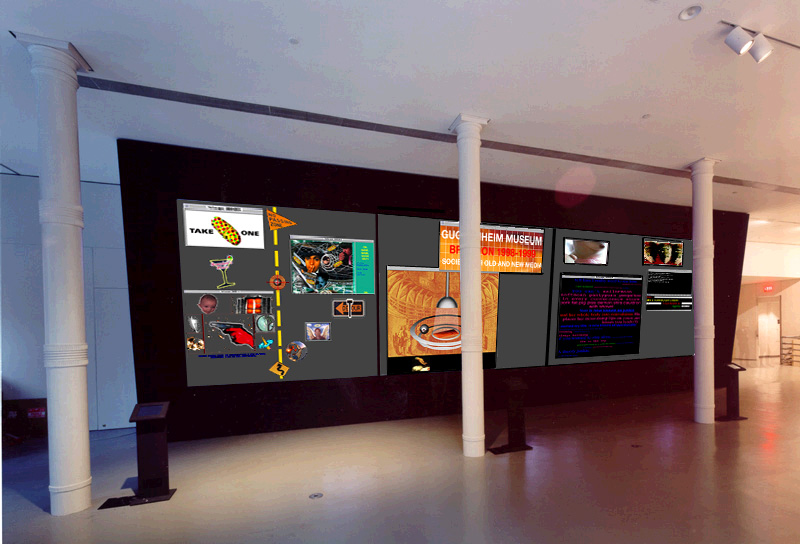
videowall#1“BRANDON was first conceived as a feature film and developed into a web narrative project. I have approached BRANDON in a film production mode and taken up the time-based video installation concept for the one year duration of BRANDON on the web. BRANDON as a multi-artist, multi-author, multi-institution endeavour is a case of my own desire to ‘hack’ the very institutionalized, structured net scape.” Shu Lea Chang.

Shu Lea Chang – in her own words

“As an artist, filmmaker, networker, Cheang constructs networked installations and multi-player performances in participatory impromptu mode. She drafts sci-fi narratives in her film scenario and artwork imagination. She builds social interface with transgressive plots and open network that permits public participation. Engaged in media activism for two decades (the 80s and 90s) in New York city, Cheang concluded her NYC period with the first Guggenheim museum web art commission/collection BRANDON (1998 – 1999).  Whilst in NYC, she made two feature films, FRESH KILL (permiered at Berlin Film festival, 1994) and I.K.U. (premiered at Sundance film festival, 2000).
“Since her relocation to Eurozone in 2000, Cheang has been staging large scale performative works in collaboration and taking on installation art projects including 3 part Locker Baby Project (2001 – 2012) and UKI viral performance viral game (2009 – 2014). Currently situated in post-crash BioNet zone, Cheang takes on viral love, bio hack in her current cycle of works.” From http://www.mauvaiscontact.info/


Basel Abbas & Ruanne Abou-Rahme: Incidental Insurgents – some influences

Basel Abbas and Ruanne Abou-Rahme (1)

Part 1, The Part about The Bandits

Films featured either as clips or stills in Incidental Insurgents, Part 1:

Wim Wenders – Paris, Texas, 1984

Jean-Luc Godard – Pierrot Le Fou, 1965

Jean-Luc Godard – Band of Outsiders, 1964

Jean-Luc Godard- Breathless, 1960

Chris Marker – Remembrance of things to Come, 2003

Chris Marker – A Grin Without a Cat, 1977

“The film’s original French title is Le fond de l’air est rouge, which means ‘The essence of the air is red’, and has a subtext similar to the English title, implying that the socialist movement existed only in the air. The title is also a play on words: The original expression in French is ‘Le fond de l’air est frais’, meaning ‘there is a nip in the air’. Chris Marker replaced the last word with ‘rouge’ (red), so the original title translates to There are Reds in the Air.” Courtesy Wikipedia.

“There are still some wolves left” (from A Grin Without a Cat – towards the end)

Solanos and Getino – The Hour of the Furnaces, 1968

photo(2)

Part 2, Unforgiving Years

Films that are among the research materials for Incidental Insurgents, Part 2:

Chris Marker – Sans Soleil, 1983

Guy Debord – Refutation of all the judgments, 1975

Guy Debord – In girum imus nocte et consumimur igni, 1978

In girum imus nocte et consumimur igni is a medieval Latin palindrome meaning ‘we turn in the night and are consumed by fire’.

Debord’s films can be found on UBUWEB here.  Sadly, the screening quality of both Refutation of all the judgments and In girum imus nocte et consumimur igni is very poor.  However, the unauthorised translation and clean-up, initiated by Ed Halter, Thomas Beard, and Buyoung Kim, and narrated by Paul Chan, is ok (see UBUWEB page).

Michelangelo Antonioni – Il Deserto Rosso, 1964

Jim Jarmusch – Stranger Than Paradise, 1984

Various Film Makers – Ten Minutes Older: The Cello, 2002

Jean-Luc Godard – La Chinoise, 1967

Jean-Luc Godard – Histoire Du Cinema, 1988

Jean-Luc Godard – Un Film Comme Les Autres, 1968

Jean-Luc Godard – Vivre Sa Vie, 1962

Jean-Luc Godard – In praise of love, 2001

Jean-Luc Godard – Masculin Feminin, 1966

photo(4)

And here’s a few books that are amongst the papers in the installation:

Roberto Bolano – Between Paratheses, 2011

Victor Serge – Resistance, ????

“Victor Lvovich Khibalchich (better known as Victor Serge) was born in Brussels, the son of Russian Narodnik exiles. Originally an anarchist, he joined the Russian Communist Party on arriving in Petrograd in February 1919 and worked for the newly founded Communist International as a journalist, editor and translator. As a Comintern representative in Germany he helped prepare the aborted insurrection in the autumn of 1923. In 1923 he also joined the Left Opposition. He was expelled from the party in 1928 and briefly imprisoned. At this time he turned to writing fiction, which was published mainly in France. In 1933 he was arrested and exiled. After an international campaign he was eventually deported from Russia in April 1936 on the eve of the Moscow Show Trials. Upon arrival in the West he renewed contact with Trotsky but political differences developed and a bitter controversy developed between the two remaining veterans of the pre-Stalinist Russian Communist Party. Escaping from Paris in 1940 just ahead of the invading Nazi troops he found refuge in Mexico. During his last years Serge lived in isolation and died penniless shortly after the 30th anniversary of the Bolshevik revolution in November 1947.” Source: Marxists’ Internet Archive.

Adrienne Rich – An Atlas of the Difficult World, 1991

Victor Serge – Unforgiving Years, ????

First published in French 25 years after his death in 1947.  An English translation only became available in 2008.

Paul Gordon – Vagabond Witness: Victor Serge and the politics of hope, 2013

Guy Debord – Panegyric, 1989

khamsin: Journal of Revolutionary Socialists in the Middle East

Victor Serge – Men In Prison, ????

Between 1912 and 1917, Serge was incarcerated in French penitentiaries:  “Everything in this book is fictional and everything is true. I have attempted, through literary creation, to bring out the general meaning and human content of a personal experience.” Victor Serge in the epigraph to Men in Prison.

Chris Kraus – Where Art Belongs, 2011

Greil Marcus – Lipstick Traces, 1989

It’s the updated 2011 edition in the installation.

McKenzie Wark – A Hacker Manifesto, 2004

Victor Serge – Birth of Our Power, ????

Composed, a decade after the revolution, in Leningrad, where Serge was living in semi-captivity because of his declared opposition to Stalin’s dictatorship over the revolution.

The Invisible Committee, The Coming Insurrection, 2007


photo(1)From The Coming Insurrection, The Invisible Committee


A Diversion … to Elena Ferrante

“I grew up with the idea that if I didn’t let myself be absorbed as much as possible into the world of eminently capable men, if I did not learn from their cultural excellence, if I did not pass brilliantly all the exams that world required of me, it would have been tantamount to not existing at all. Then I read books that exalted the female difference and my thinking was turned upside down. I realized that I had to do exactly the opposite: I had to start with myself and with my relationships with other women—this is another essential formula—if I really wanted to give myself a shape. Today I read everything that emerges out of so-called postfeminist thought. It helps me look critically at the world, at us, our bodies, our subjectivity. But it also fires my imagination, it pushes me to reflect on the use of literature. I’ll name some women to whom I owe a great deal: Firestone, Lonzi, Irigaray, Muraro, Caverero, Gagliasso, Haraway, Butler, Braidotti.”
“I hold that male colonization of our imaginations—a calamity while ever we were unable to give shape to our difference—is, today, a strength. We know everything about the male symbol system; they, for the most part, know nothing about ours, above all about how it has been restructured by the blows the world has dealt us. What’s more, they are not even curious, indeed they recognize us only from within their system.”
Thanks to Sarah Shin at verso for sending the quotes (hence, not sure of the ultimate source).