Carroll / Fletcher

The Lament of the Unlamented

Mikhail-Karikis-Sounds-from-Beneath-web3

From 7 January Carroll / Fletcher Onscreen will be showing Sounds from Beneath, the second part of Mikhail Karikis’s Work Quartet.  The following section is the first part of a text Mikhail wrote for Voice Studies: Critical Approaches to Process, Performance and Experience (Routledge, 2015), which reflects upon the origin, making and sonic structure of the film.

“What are the sounds specific to this community and how are they remembered? Are official language and ceremony adequate memory keepers of the miners, their achievements, resistance and culture?” Mikhail Karikis.

Sounds from Beneath: the lament of the unlamented

The project Sounds from Beneath emerged as an artistic response to an invitation by an arts festival in Kent in South East England to create a site-specific work. The piece orchestrates an aural reunion of a group of former coal miners on a disused colliery, and discovers a mode of voicing that responds to their professional specificity, charged with the political and historical dimensions of their community and culture.

Rich in its industrial history from the time when coal played a primary role in British life, fuelling domestic fires and industrial furnaces, and stimulating the socio-political and cultural life of the country – from unions to choirs – the Kentish landscape is marked by the radical urban, social and economic changes that have taken place in Britain since the mid 1980s. Lush green hills are punctuated by barren and disused collieries, vast shopping malls, former mining villages and their alienated regenerated versions. Kent was a place of intense coal mining activity, where local and migrant miners and their families lived, worked, and partook in the cultural and political life that characterized the mining community. Since the dismantling of the coalmining industry in England in the ‘80s, the Kentish coalmines have stood silent.

Despite the striking muteness of the empty pits, what is still audible, through the spoken memories of old ex-miners, is the generational passage of song and story in the vivid language of the miners, which has kept account of their history and tradition, giving voice where official narratives and histories have denied it. Traces of such sounds and memories can still be heard in some village pubs and mining welfare clubs and choirs where former colliers socialise and sing. But what sounds are specific to this community and how are they to be remembered? Are official language and ceremony adequate memory keepers of the miners, their achievements, resistance and culture?

Defeated by the state, the coal miners did not receive official praise, nor were they nationally ceremonially mourned as they fell in combat with the state’s interests. Both official praise (through civic speech), and ceremonial mourning (through religious or formal musical rituals) are vocal acts designed to introduce the fallen into the realms of glory and historical memory. They also have a role to play in managing public grief and supressing expressions of resentment. In the case of fallen soldiers, who are sent by the state itself to the battlefield, ceremonies and speeches manage trauma and control rage, which may threaten public order. As vocal acts, they are essentially control strategies of public expressions of grief, giving articulate and restrained shape to sorrow. Civic speeches and formal rituals are directed to the nation and are experienced communally, overwhelming individual lament in its manifestation of despair, trauma and fury at the cause of harm, and its potential to lead to reciprocal violence and subsequently shake the stability of the state and challenge its leadership. As Gail Holst-Warhaft observes in her study of traditional ritual laments practiced by women in Greece and across many parts of the world, lamenting has often been supressed and antagonized by official authorities due to its open expression of personal anger at the cause of death, and its refusal to acquiesce with the state’s demand for men to die in its defence.

Ethnographic film projects such as Cecila Mangini’s ‘Stendali’ indicate that as vocal acts, laments operate outside official language; they inhabit the marginal space of dialect and idiom, and include extra-lingual vocal gestures such as shouts, sighs, cries and sobs. Laments present personal narratives that summarise the dead relative’s life and the emotional impact of his/her loss. In contrast, official national mourning is a form that finds expression in articulate vocal acts which assert the state’s authority over death, remember its fallen as citizens, and ultimately supress and tame inarticulate pain and anger by channelling them into feelings of pride and nationalism. While lament narratives tie the bodies and personal memories of dead relatives to a physical location and give a sense of subjective and site-specific concreteness to the otherwise abstract nothingness of death, national mourning aims to provide an abstract raison d’être for death in defence of the nation. It insists that posthumous glory outweighs private grief, and inspires new generations to fight for a state that glorifies its fallen in a uniform comradeship beyond physical defeat. Women’s laments are infused by a logic of care that privileges birth and makes an enemy of the cause of death. They voice the preservative role of love and oppose the military destruction of life, thus presenting a de-militarised conception of human life and the body, which transcends civic and military function.

While the above suggests a conflict of interests inherent in any attempt to make civic speech a memory keeper of the miners’ culture and achievements, it also presents the female practice of lamenting as a model of voicing loss, which exists outside official language and shakes its authority. Therefore, if there is to be a mode of vocal production that expresses the narrative of disempowerment of the miners, it must gain the subversive dynamics and challenging power of women’s laments, while expressing the miners’ cultural specificity.

Returning to the issue of identifying the sounds that are specific to the mining community, my field research for Sounds from Beneath revealed some stark facts. In my exploration of the region of Kent, I visited local pubs and mining welfare clubs where old miners gather to socialise. In 2010, at the back of Snowdown Colliery Welfare Club, I discovered a choir of elderly former miners, who regularly rehearse in a large barrel-shaped dance-hall a repertoire that ranges from miners’ anthems to Broadway songs – the former singing of past strength and the miner’s hardships, the latter offering light entertainment. This vast gap in content and sentiment in the choir’s repertoire was a poignant signifier of the alienation and abrupt interruption of the miners’ choral tradition, which was entwined with their workplace and the union. Sung outside the work context and recounting past narratives, the choir’s mining songs are heard like dusty historical records temporally disconnected from the present.

Beyond the choir’s mining songs however, the work of the collier was itself sonorous, as was the working mine with its powerful soundscape of excavating the earth. From the rumble of subterranean explosions to the scratching of shovels, each part of the coal mining process was sonically distinct, making sound practice the by-product of the miner’s labour. The soundscape of the mine formed a profession-specific noise composition, which followed the rhythms of the working day. Its noise connected the miners’ labour with the site of their work, and produced an aural signifier of the mining community, identity and profession.

Although mining sounds have stopped resounding in the Kentish collieries, they still exist in the aural memories of former miners. In my search for sounds specific to the their community, I collaborated with Snowdown Colliery Choir and asked them to recall and vocalise the sounds they used to hear when they worked in the mines. In a subsequent film entitled Sounds from Beneath, the choir sing noises that evoke the coalmine standing on the disused Tillmanstone Colliery near Dover. Mechanical clangs, whirring engines, wailing alarms, subterranean blasts, scratching, hissing and whistling vocalised by the men reanimate the empty pits. Detached from their original source and emanating from the aging bodies of the miners on the colliery, these noises re-establish a connection between the labour of mining and the body, site and memory, humans and machines. Their song presents the men with a reason to come together again and transforms the desolate site into an amphitheatre of communal remembering forming a subjective and site-specific record of former activity and community. But these are not sounds as they used to resound across the mine in the past; they are aural recollections as they exist in the embodied present, marked by the texture of the half-remembered and of time passing. The miners unearth a suppressed memory of loss, and compose a re-collective lament outside the confines of language, both resisting social inaudibility and resonating beyond the silence of vanished industrial architectures.

 Courtesy Mikhail Karikis and Routledge


The Work Quartet – Xenon

Mikhail Karikis

Xenon

2011 | 23:31 | 16:9 | stereo | HD

December 18 2015 – January 7 2016

Mikhail-Karikis-Xenon-video-still-web3

Synopsis

Xenon opens with a vision of a zombie beating a drum, the scene shifts to a blistering figure in a basement. Meanwhile, in an austere office upstairs, the unusual absence of a colleague (who haunts the film in the figure of the zombie)  trigger unlikely reactions in seven characters working in the claustrophobic routine of an austere office. Yearning to overcome their oppressive circumstances and pursuing the impossible, each character enters an imaginary space where s/he battles with self-censorship, frustration, high aspirations and failure. The bare banality and bleak automation in the office are juxtaposed with striking dream-like sequences staging each character’s quest, including an office worker’s attempt to flee from his chair, the recitation of the Declaration of Human Rights from memory and an encounter with the Ferryman of Death.

Mikhail-Karikis-Xenon-video-still-web2

The film Xenon is based on an ambitious performance project entitled Xenon: an exploded opera. It is a critical political allegory reflecting on the global economic upheavals post-2008 and the state of human rights, and explores the politics of work, notions of censorship and freedom of speech. The piece is set in a fictional professional context of an office and explores notions of freedom of expression and self-censorship, asking ‘under what conditions of pressure do we forget our human rights?’

The Universal Declaration of Human Rights

Article 1: All human beings are born free and equal in dignity and rights. They are endowed with reason and conscience and should act towards one another in a spirit of brotherhood…

Article 23: (1) Everyone has the right to work, to free choice of employment, to just and favourable conditions of work and to protection against unemployment; (2) everyone, without any discrimination, has the right to equal pay for equal work; (3) everyone who works has the right to just and favourable remuneration ensuring for himself and his family an existence worthy of human dignity, and supplemented, if necessary, by other means of social protection; (4) everyone has the right to form and to join trade unions for the protection of his interests.

Article 24: Everyone has the right to rest and leisure, including reasonable limitation of working hours and periodic holidays with pay.

Article 25: (1) Everyone has the right to a standard of living adequate for the health and well-being of himself and of his family, including food, clothing, housing and medical care and necessary social services, and the right to security in the event of unemployment, sickness, disability, widowhood, old age or other lack of livelihood in circumstances beyond his control… [read the whole document here].

Mikhail-Karikis-Xenon-video-still-web6

Credits

Written & composed by: Mikhail Karikis
Directed & edited by: David Bickerstaff & Mikhail Karikis
Costume and sets by: Mikhail Karikis
Produced by: Mikhail Karikis & David Bickerstaff
Second Camera: Uriel Orlow
Cast: Maurice Causey, Amy Cunningham, E.laine, Conall Gleeson, juice, Mikhail Karikis, Jade Pybus, Monica Ross
Funded by: Art Council England
Support in kind by: University of Brighton

Mikhail Karikis

Mikhail Karikis (b.1975, Thessaloniki, Greece) studied architecture at the Bartlett School before completing an MA and PhD at the Slade School of Fine Art. He lives and works in London. Selected solo and group exhibitions include British Art Show 8, Leeds Art Gallery, UK; Art in the Age of Energy and Raw Material, Witte de With, Rotterdam, Holland (both 2015); Listening, Hayward Touring, UK (2014-15); 19th Biennale of Sydney, Australia; Inside, Palais de Tokyo, Paris, France; Assembly, Tate Britain, London, UK (all 2014); Aquatopia, Tate St. Ives and Nottingham Contemporary, UK (2013-14); SeaWomen, Arnolfini, Bristol, UK (2013); Manifesta 9, Belgium (2012); and the 54th Venice Biennale, Italy (2011). A more detailed cv can be found here.

http://www.mikhailkarikis.com/

Mikhail-Kairkis-SeaWomen-production-photograph-web2

The Work Quartet

Karikis began the Work Quartet in 2010. Each work in the series explores similar issues; the relationships between voice and specific communities, between subjects and work contexts and the possibility of alternative modes of organisation, of a new political imaginary. The series is made up of: Xenon (2011) – exploring frustration, self-censorship and sense of failure in office work environments; Sounds from Beneath (2011) – a collaboration with a Kentish miners’ choir that bring back to life an abandoned colliery by collectively recalling, vocalizing and singing the sounds and noises of their former place of work; SeaWomen (2012) – a body of works focused on a community of Korean female fishers and on their specific vocal practice; and Children of Unquiet (2014) – a collaboration with a group of 45 children, aged between 5 and 12 years old from the Devil’s Valley region of Tuscany, Italy, in which the children ‘takeover’ an abandoned industrial village, the children’s speculative and playful interventions challenge narratives of a failed human project and evoking different possible, desired or imagined futures.

Mikhail Karikis - Children of Unquiet (2013-2014) video still-2

Mikhail Karikis on The Work Quartet – from an interview with Digicult

“On an emotional level, the series suggests a sort of progression. Xenon expresses the kind of state of mind I was in when I made it. I felt trapped. It was less than ten years after 9/11, in a period were political changes were happening and neo-liberalism in UK and Europe was celebrated, before the Occupy Movement and the turbulent student protests in the UK and across Europe. So the main question was: how can we express ourselves if the power of political speech and language has been hollowed out?

“In this regard, Sounds from Beneath was a kind of solution (perhaps ‘solution’ is not the right word here, but it was a kind of solution in terms of my practice) where I explored the possibility of creating a political vocal gesture that was neither propaganda nor sloganistic speech. The miners vocalize something that is connected to the specificities of what they did, their memory and community, and at the same time they reclaim the political agency they were denied in their protests and strikes. Their abstract vocal acts are specific to their community and go beyond predictable political speech. At that point, something happened in my practice and in my thinking. Yet, I was still engaging with memory – with something that had happened in the past and was reactivated now in the form of recalling.

“This is the reason why SeaWomen had to happen: the project is about a disappearing but still active, independent, self-sufficient and dynamic community of women subverting expectations of the male-dominated context they exist in. SeaWomen was the first project that marked a change in the way I felt in terms of my agency as an artist and the way I can affect the world around me. I think of Xenon as a sort of ‘toxic’ work in that it is very critical, punishing and polemical; Sound from Beneath is a re-collective lament, while SeaWomen displays dynamism – the old women’s bodies are active and powerful and represent a model of existence that gave me hope.

“So, moving to Children of Unquiet was deeply meaningful in my practice. It encapsulates this process and could not have happened four years ago. It needed the background of all the other projects and research. For the first time, I worked with children. The project poses questions about the future: what do we leave to the next generation, how do we empower them to change things? Moreover, if we talk about the film, it actually has glimpses and methodologies of all the other projects: the recalling of sounds of specific places, for example, or the acts of speech that are somehow subverted. These are elements I developed by working on the projects that preceded it.”

The full interview can be found here.

Courtesy of Mikhail Karikis, Elena Biserna and Digicult.

“What do we leave to the next generation, how do we empower them to change things?” Mikhail Karikis

Love as a political force?

“Love is an institution of revolution.” Michael Hardt and Antonio Negri, Commonwealth, 2009

“So love, simultaneously, is a revolutionary force and creates sustainable bonds that resist change. Hardt and Negri transpose these observations in the field of politics by asking: how is it possible to think of a political system that exists through revolution and constant change and, at the same time, creates sustainable bonds? For me this seems to be the fundamental question in relation to industrial village of Larderello in the project Children of Unquiet. There was a pioneering, innovative industry – they invented geothermal energy production – that was possible only because of change. A community was created because of that – people moved there to work, to operate the power plant. The industry did not stop changing and introduced automated technology. This shift created a fracture and disrupted the connection with the community. The industry was not able to sustain its bonds with the people that made it happen in the first place. Why was that? How is that possible? If we think through Negri and Hardt’s ideas, that change should have engaged the community so that those bonds would not have been destroyed. ‘Love is the institution of revolution” is really about this. We usually think of institutions as stable and revolution as a change, but love contains this contradictory dynamic – it is able to create both stability and change. I really stand by that.” Mikhail Karikis in an interview with Elena Biserna in Digicult.  The full interview is available here.

Mikhail Karikis - Children of Unquiet (2013-2014) video still-4

From Children of Unquiet, Hardt and Negri on love

Love is not a spontaneous or passive experience.

Love doesn’t just happen to us.

Love is an action…

it’s a biopolitical event realised in common.

Love is a productive force.

In love we produce a new world, a new social life.

We exist in relation to others and we constantly have the power to intervene.

Here is a puzzle about love:

it shatters the structures of the world you know and creates a new world.

In love, you gain a new body, a new being.

But love also has another, seemingly opposite face.

Love binds you in a way that feels it will last forever.

So, we are left with two notions of love that are equally unlivable.

One: that love is all about change. Two: that love admits no change.

The two faces of love pose a problem when considered in political terms.

On the one hand, a political love must be a revolutionary force…

Overthrowing norms and institutions.

On the other hand, a political love must provide mechanisms of lasting association…

And table social bonds to create enduring institutions.

Love is an institution of revolution.

A transcript from Children of Unquiet of children reading from Michael Hardt and Antonio Negri’s, Commonwealth, 2009.

Simon Critchley on love as the faith of the faithless

“In a word, the institutions of secular liberal democracy simply do not sufficiently motivate their citizenry… one might go further and argue that modernity itself has had the effect of generating a motivational deficit in morality that undermines the possibility of ethical secularism.” Simon Critchley, Infinitely Demanding – Ethics of Commitment, Politics of Resistance, verso books, 2008, pp.7-8.

“Politics is always about nomination. It is about naming a political subjectivity and organizing politically around that name.” Simon Critchley, Infinitely Demanding – Ethics of Commitment, Politics of Resistance, 2008, verso books, p.103.

“The massive structural dislocations of our times can invite pessimism, even forms of active or passive nihilism… but they can also invite militancy and opitimism, an invitation for our capacity for political invention and imagination, an invitation, finally, for our ethical commitment and political resistance… It is time we made a start.” Simon Critchley, Infinitely Demanding – Ethics of Commitment, Politics of Resistance, 2008, verso books, p.131-2.

“If political life is to arrest a slide into demotivated cynicism, then it would seem to require a motivating and authorising faith which, while not reducible to a specific context, might be capable of forming solidarity in a locality, a site, a region… This faith of the faithless cannot have for its object anything external to the self or subject, any external, divine command, any transcendent reality.” Simon Critchley, The Faith of the Faithless, 2012, verso books, p.4.

“A faith of the faithless that is an openness to love, love as giving what one does not have and receiving that over which one has no power.” Simon Critchley, The Faith of the Faithless, 2012, verso books, p.7.

“[A] politics of love, in which love is understood as that act of absolute spiritual daring that attempts to eviscerate existing conceptions of identity in order that a new form of subjectivity can come into being.” Simon Critchley, The Faith of the Faithless, 2012, verso books, p.12.

“For reasons that are still slightly obscure to me, but which this book begins to clarify, the question ‘how to live?’ has become the question ‘how to love?’ Love is not just a s strong as death – it is stronger.” Simon Critchley, The Faith of the Faithless, 2012, verso books, p.20.

Mikhail-Karikis-Sounds-from-Beneath-web3

The use of sound in The Work Quartet

“Sound is our guide; it choreographs the filmic sequence, our visual experience and our attention.” Mikhail Karikis.

“A distinctive and original dimension of this body of work [The Work Quartet] is its audiovisual methodology which combines social engagement and community performances, moving image and sound installation creating immersive displays. The works in the Quartet centre on distinct auditory concepts and focus on sound as a vehicle of human memory, imagination and action. They explore the voice and communal sound-making as agents connecting people to specific sites of production, asserting human dignity and purpose through work, as well as highlighting alternative models of existence, activism and industry, evoking both past histories as well as different, probable or imagined futures.” Mikhail Karikis.

“I’m very interested in nonsense sounds because they seem to break free from the rigorous structures of language and make us think about vocal communication in a different way.” Mikhail Karikis.

Links

Artists website.

Interview with Yvette Greslé in FAD Magazine.

Interview with Elena Biserna in Digicult.

Children of Unquiet website.

Mikhail Karikis at British Art Show 8.

Interview with British Art Show 8.

Fresh Kill

Shu Lea Cheang

Fresh Kill

1994 | 01:18:41 | Colour | Stereo | 4:3 | 35mm

December 8 – December 17, 2015

Synopsis

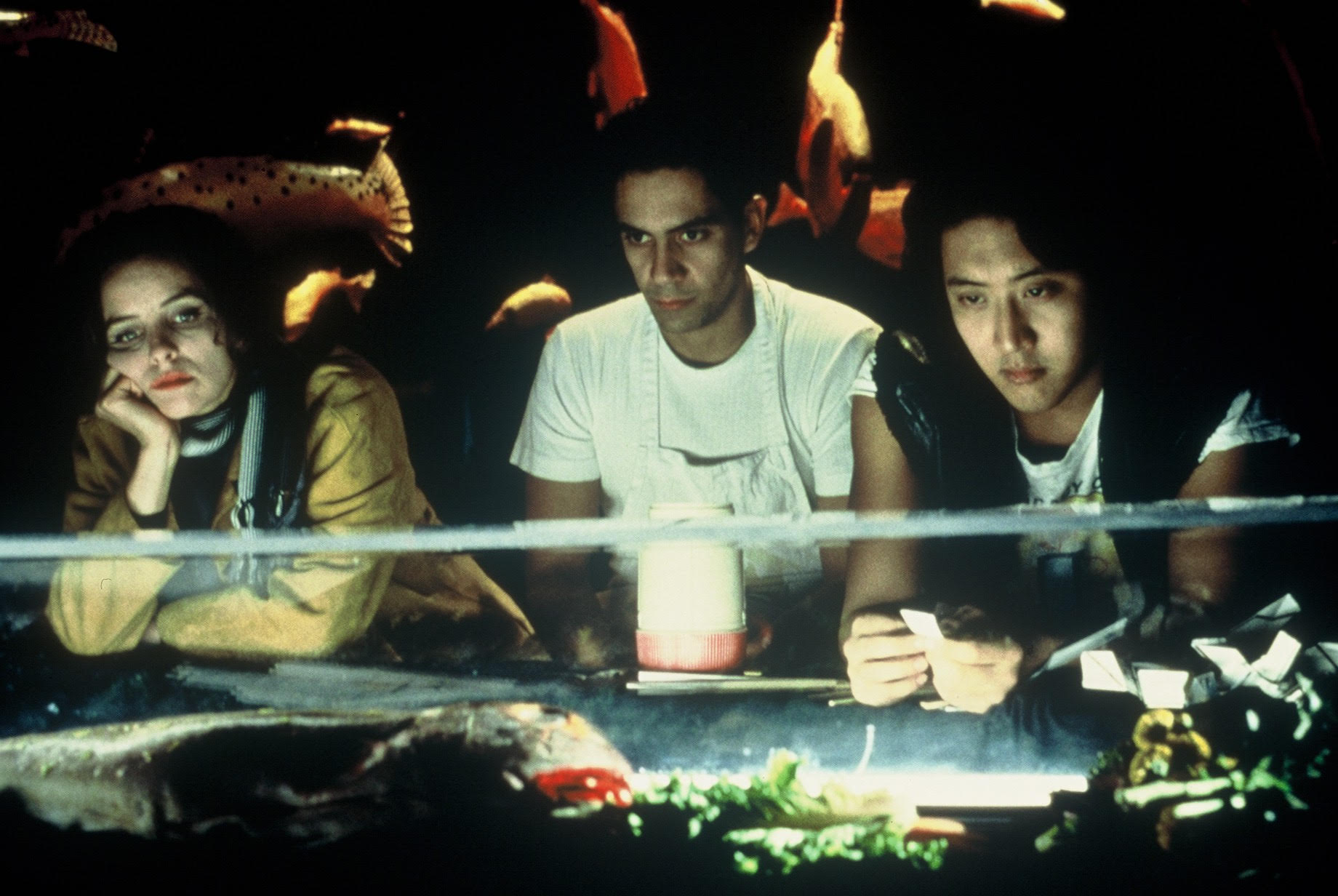
Fresh Kill tells the story of two young lesbian parents caught up in a global exchange of industrial waste via contaminated sushi. The place is New York and the time is now. Raw fish lips are the rage on trendy menus across Manhattan. A ghost barge, bearing nuclear refuse, circles the planet in search of a willing port. Household pets start to glow ominously and then disappear altogether. The sky opens up and snows soap flakes. People start speaking in dangerous tongues.

Fresh Kill premiered at the Berlin Film Festival, Berlin in 1994.  In 1995, it featured in the Whitney Biennal, New York and was broadcast on Channel Four in the UK.

Screen Shot 2015-12-04 at 12.05.51

“Fresh Kill operates on a faith in media activism and the emancipatory potential of the digital. Commercial media penetrate into the social and psychological fabric of daily life, but they can be resisted. Fresh Kill offers itself as an example of that resistance while providing models for potential hackers and cable activists in the audience. Like the works of Brecht and Godard, it offers hope for seizing  the means of communication by reflecting on its own production and providing an image of radical media empowerment to inspire others.” Gina Marchetti, 2001.

Shu Lea Cheang in conversation with Lawrence Chua – BOMB Magazine, Winter, 1996

“Lawrence Chua: What was your emotional attachment to the narrative? You came up with the idea and then approached Jessica Hagedorn [the writer], right?

“Shu Lea Cheang: There was a certain political agenda we wanted to deal with, in terms of media and environmental racism. That environmental racism was manifested in the transport of industrial toxic waste to Third World countries. Right from the beginning, we made a parallel between the waste and the dumping of garbage TV programs into Third World countries. Basically, once that was constructed, it seemed like we kept on making parallels. You have First World/Third World, then you have New York City/Staten Island, and even within New York City, you have “Tent City” (a makeshift community of homeless people) as a kind of garbage dump. We set up a bunch of characters with the intention of trying to reverse stereotypes. Right from the beginning we wanted to have this Asian hacker, who was also this quiet sushi chef; a lesbian couple . . . There were all these preset characters we wanted to put into the landscape… [read the whole interview here].”

Courtesy: BOMB Magazine, Shu Lea Cheang and Lawrence Chua.

unnamed

Fredric Jameson on the ‘conspiratorial text’: “Whatever other messages it [the conspiratorial text] emits or implies… may also be taken to constitute an unconscious, collective effort at trying to figure out where we are and what landscapes and forces confront us in a late twentieth century whose abominations are heightened by their concealment and their bureaucratic impersonality… Nothing is gained by having been persuaded of the definitive verisimilitude of this or that conspiratorial hypothesis:  but in the intent to hypothesize, in the desire called cognitive mapping – therin lies the beginning of wisdom.” Fredric Jameson, The Geopolitical Aesthetic: Cinema and Space in the World System, 1995.

Shu Lea Cheang

As an artist, conceptualist and filmmaker Shu Lea Cheang constructs networked installations and multi-player performances. In her film scenarios and artworks, she drafts sci-fi narratives and builds participatory social interfaces and open networks. Engaged in media activism with transgressive plots for two decades (the 80s and 90s) in New York City, in 1998 Cheang concluded her NYC period with the first Guggenheim Museum web art commission BRANDON (see www.carrollfletcheronscreen blog).  Cheang has expanded her cross-genre-gender borderhack performative works since relocating to the Eurozone in 2000. Currently situated in post-net BioNet zone, Cheang is composting the city/the net while mutating viruses and hosting seeds through underground parties.

Cheang has made two feature films, FRESH KILL (permiered at Berlin Film festival, 1994) and I.K.U. (premiered at Sundance film festival, 2000).  Her third film, FLUIDØ is currently in production:

“FLUIDØ  is set in the post-AIDS future of 2060, where the Government is the first to declare the era AIDS FREE, mutated AIDS viruses give birth to ZERO GEN – humans that have genetically evolved in a unique way. These gender fluid ZERO GENs are the bio-drug carriers whose white fluid is the hypernarcotic for the 21st century, taking over the markets of the 20th century white powder high. The ejaculate of these beings is intoxicating and the new form of sexual commodity in the future. The new drug, code named DELTA, diffuses through skin contact and creates an addictive high. A new war on drugs begins and the ZERO GEN are declared illegal. The Government dispatches drug-resistant replicants for round-up arrest missions. When one of these government android’s immunity breaks down and its pleasure centers are activated, the story becomes a tangled multi-thread plot and the ZERO GENs are caught among underground drug lords, glitched super agents, a scheming corporation and a corrupt government. Check yourself in as a fluid junkie for a super hyper viral ride.”

For more details and a cv see http://www.mauvaiscontact.info

Fresh Kill Credits

FRESH KILL, an eco-cybernoia film. An airwaves project in association with Woo Art International, ITVS and Channel 4, UK.

Director: Shu Lea Cheang

Writer: Jessica Hagedorn

Cast: Sarita Choudhury, Erin McMurtry, Abe Lim, Jose Zuniga, Laurie Carlos, Will Kemp, Nelini Stamp and Rino Thunder

Producer: Jennifer Fong

Associate producer: Shari Frilot

Music: Vernon Reid

Cinematography: Jane Castle

Film editing: Lauren Zuckerman

Production design: Nancy Deren

Art direction: Michael Nino

Sound editor: Margaret Crimmins

FreshKillPoster (1)