Other Contemporary Materialities
A Group Show Curated By Constant Dullaart
12 April 2016 – 25 April 2016
Introduction
In Other Contemporary Materialities Dullaart provides a counterpoint to his solo online exhibition Contemporary Materialites or smth . Direct links can also be traced to Dense Mesh, a group exhibition curated by Joshua Citarella on display 14 April 2016 to 25 May 2016 in Carroll / Fletcher’s Eastcastle Street gallery , and the Experimental Writing Series, conceived in collaboration with the Institute for Contemporary and Modern Culture, University of Westminster. The exhibition is followed by an Afterword that is a continuation of the Afterword that accompanied Dullaart’s solo exhibition.
Other Contemporary Materialities

wwwwwwwwwwwwww.net, Jonas Lund, 2011, website
Unique, courtesy Jan Robert Leegte Collection
The work is located here: http://wwwwwwwwwwwwww.net
The page lists, from top left to bottom right, the million most visited websites (downloaded on 12 December 2011 from Alexa). On first encountering http://wwwwwwwwwwwwww.net, the only visible names are those of the websites that the viewer has visited (using the same browser as the one being used to access the work) – the display is created by the website accessing the viewer’s history cache (to confirm this try Clearing Browsing Data/History then reloading the work). The other websites can be viewed by right-clicking on the white space.
A minor diversion inspired by http://wwwwwwwwwwwwww.net:
http://automatedbeacon.net, Thomson & Craighead, 2005
“BEACON continuously displays live web searches. It first began broadcasting online at midnight on January 1st 2005. It has been instigated to act as a silent witness: a feedback loop providing a global snapshot of ourselves to ourselves in real-time.” Thomson & Craighead. The BEACON exists in three instantiations: a website, a wall projection, and a railway flap sign.
http://imhereandthere.com, Jonas Lund, 2011
In 2011, Jonas created an extension that sends every website he’s viewing to http://imhereandthere.com. It refreshes when a new website is visited. “It works a bit like a mirror to my browser and life – you can now see what I see.” Jonas Lund.
Somewhat ironically, this was displayed when the work was accessed: http://www.newyorker.com/magazine/2016/04/11/gay-talese-the-voyeurs-motel
“For Life Sharing we turned our private lives into a public artwork. We made each and every file on our computer, from texts and photos to bank statements and emails, available to anyone at any time through our website. Unlike social networks, which didn’t exist at the time, its focus was sharing. Anything on our computer was available to search, read and freely copy, including the system itself, since we were using only free software.” Eva and Franco Mattes.
“Life Sharing is abstract pornography.” Hito Steyerl.
ethereal self, Harm van den Dorpel, 2008
Unique, courtesy Miltos Manetas/Electronic Orphanage Collection
The work is located here: http://etherealself.com
When the work is opened a pop-up window is displayed:

If the viewer clicks on ‘Deny’, a static diamond is displayed; if the viewer clicks on ‘Allow’, the diamond shimmers with a portrait of the viewer sourced from the device’s built-in camera. As the viewer gazes at their image the device’s camera allows the work to record the viewer – “If you click Allow, you maybe recorded” – and the videos are archived to provide the images for…

ethereal others, Harm van den Dorpel, 2008
Unique, courtesy Miltos Manetas/Electronic Orphanage Collection
The work is located here: http://etherealothers.com
If you check back in a few days time you’ll find yourself a participant in a collective snapshot-portrait of our viewing habits – http://etherealothers.com – and if you leave your camera on too long you may even feature in a movie: Ethereal Others When No One is Looking, Harm van den Dorpel, 2009 – 2014.
Another minor diversion, this time inspired by http://etherealself.com and http://etherealothers.com:
http://thisplaceintime.net, Jonas Lund, 2011. This Place In Time displays the location of all visitors to the website, continuously updated and centered on the location of the last visitor; slowly collecting every spot in the world.
http://citizen-ex.com, James Bridle, 2015. “Every time you connect to the internet, you pass through time, space, and law. Information is sent out from your computer all over the world, and sent back from there. This information is stored and tracked in multiple locations, and used to make decisions about you, and determine your rights. These decisions are made by people, companies, countries and machines, in many countries and legal jurisdictions. Citizen Ex shows you were those places are… [more here].” James Bridle.
The Others, Eva and Franco Mattes, 2011. “A slideshow of 10,000 photos appropriated from unaware random people’s personal computers. Technically, the act of obtaining the images did not involve any hacking but took advantage of a software glitch.” Eva and Franco Mattes.
clear.gif, Olia Lialina, 2013, website
Unique, courtesy Evan Roth Collection
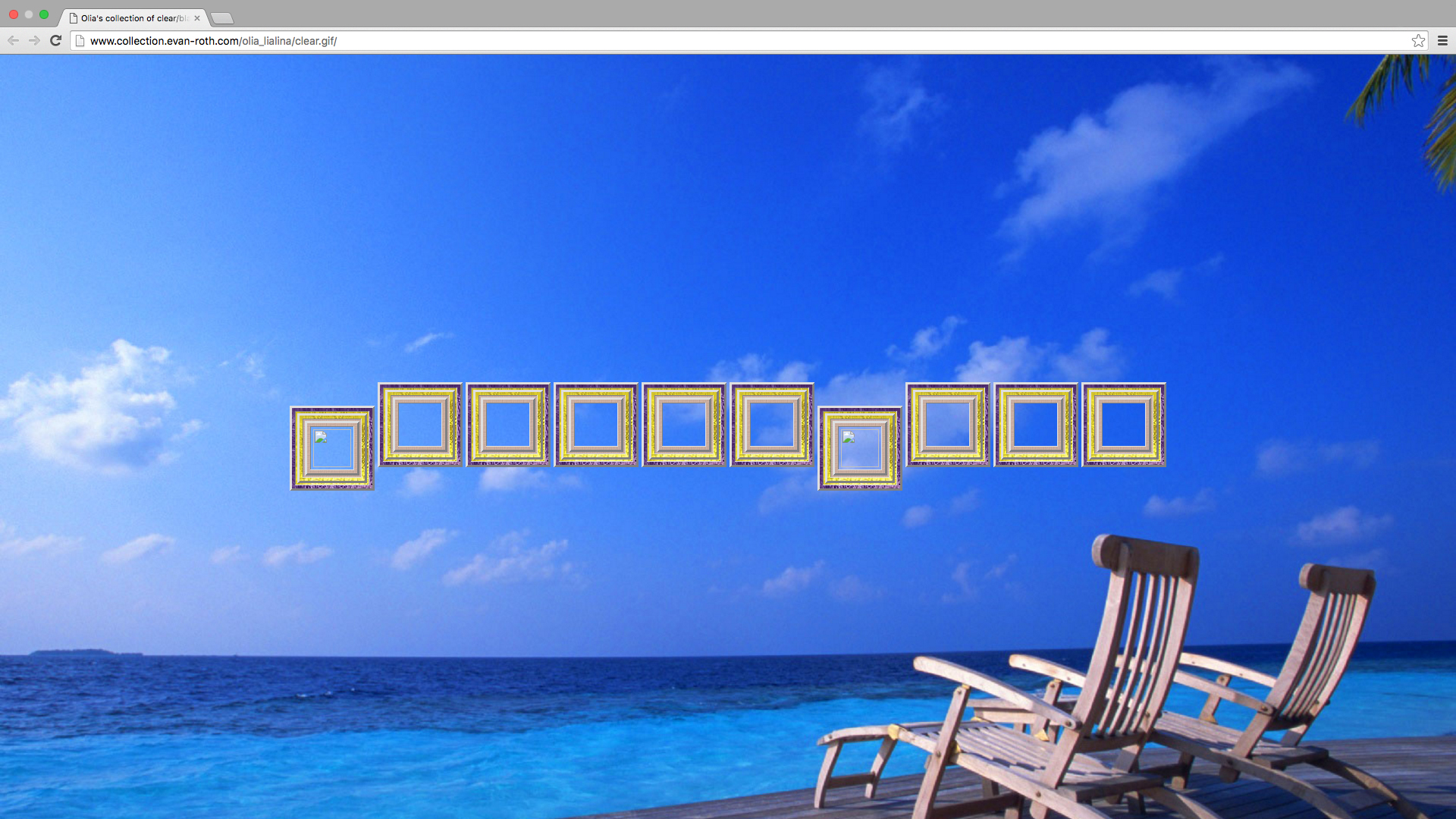
The work is located here: http://www.collection.evan-roth.com/olia_lialina/clear.gif
clear.gif is a collection of ten clear (transparent) gifs, artefacts from old web design technologies that enabled the layout of web pages; tangible yet invisible objects that separate and, hence, provide structure.
Listen to Olia talk about the work here.
As ever with Lialina’s work the simple celebration of the folk art and technologies of the internet is cut with a penetrating socio-political critique. The idyllic, apparently isolated, beach that, through the use of the internet, can connect and interact with the world is slowly disappearing as governments and corporations seek to control and structure the internet – two of the websites are no longer reachable. In this respect, clear.gif provides an interesting companion piece to the artist’s Summer (2013) and Best Effort Network (2015), and Constant Dullaart’s Jennifer in Paradise Series (here and here).

ᒥ.com, JODI, 2015, website
Unique, courtesy Jonathan Hirschfelt collection
The work is located here: http://ᒥ.com
http://ᒥ.com is part of the Apache is functioning normally series of one-letter websites in which the url is the sole content of the work. The letters are drawn from different, often little-known, alphabets and their simple elegance helps create minimal, abstract works reminiscent of concrete poetry. In http://ᒥ.com, whilst the page remains blank, the address bar, tab and history cache hypnotically loop between three websites. In contrast, in http://xn--8o7a.com the page rhythmically fills with the glyph.
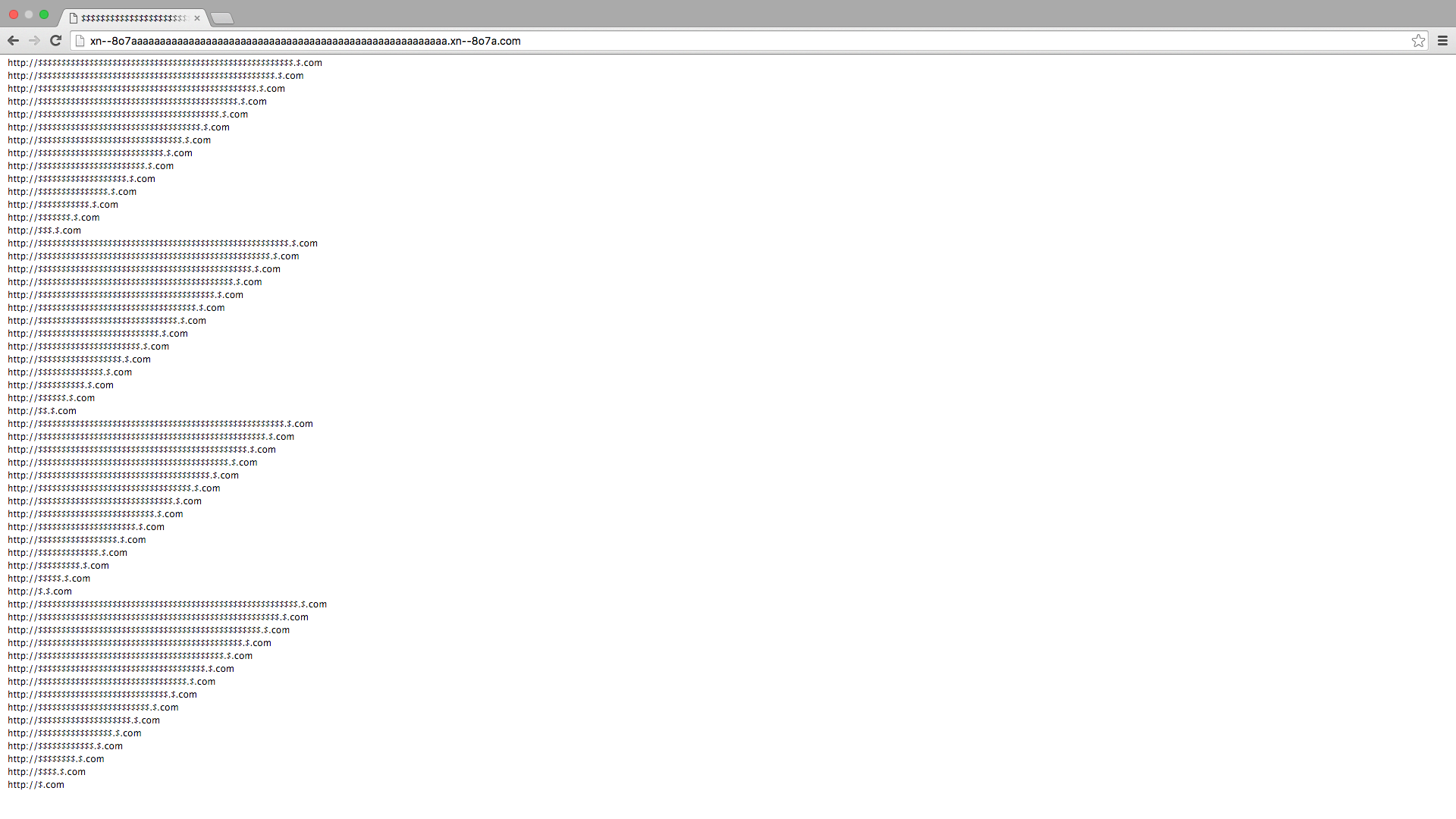
Screen shot showing a static image of http://xn--8o7a.com.
The aesthetic of each work subtly changes when viewed within different browsers. The website http://idn.jodi.org details the symbols used.
All HTML, Evan Roth, 2011, website
Unique, price on application
The work is located here: http://all-html.net
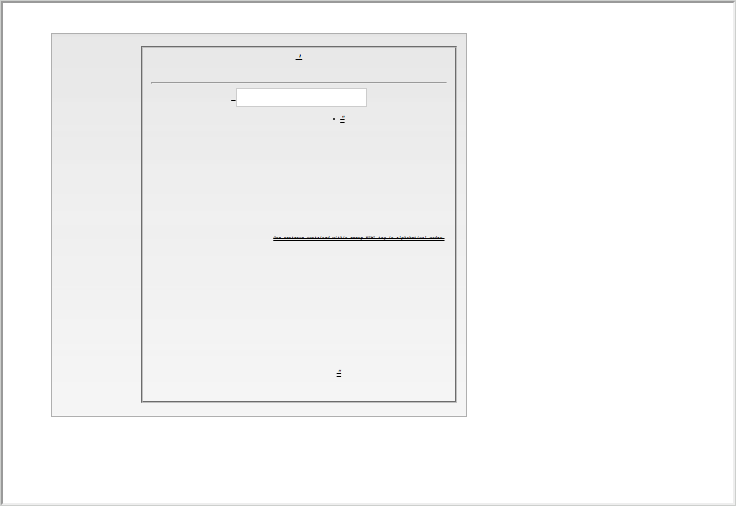
At first sight, http://all-html.net consists of a static address bar and a relatively small grey rectangle in the top left corner. However, if one zooms in, a sentence resolves itself: “One sentence contained in every HTML tag in alphabetical order”. HTML, Hyper Text Mark-up Language, is a computer language designed to allow the, relatively straightforward, creation of websites. HTML tags are the commands that tell the browser how the page should look. http://all-html.net is composed using all the HTML tags in alphabetical order to instruct the browser how to display the sentence: “One sentence contained in every html tag in alphabetical order”. This can be appreciated by viewing the source code of the work. How does the viewer access the source code?
In Chrome menu bar: View/Developer/View Source
In Firefox menu bar: Tools/Web Developer/Page Source
In Safari menu bar: Safari/Preferences/Advanced – check show Develop menu in menu bar/Develop/Show page source
Following http://all-html.net, Evan has continued to explore the aesthetic possibilities of composing a website based on using all the HTML tags in alphabetical order; of finding a visual representation for the entire HTML language, which forms the basis of our day-to-day experience of the world wide web. For example: http://one-url-contained-within-every-html-tag-in-alphabetical-order.com (2013). The source code, perhaps, best reveals why the Evan considers these works to be text pieces.

Screen shot showing a partial view of the source code of http://one-url-contained-within-every-html-tag-in-alphabetical-order.com, courtesy Sobre collection.
Artists’ interest in the poetic possibilities of the source code can be traced, in part, to JODI’s seminal work from 1995 http://wwwwwwwww.jodi.org (viewing the source code is highly recommended…).

clouds, Olia Lialina, 2014, website, tab 3 of a four tab browser installation, 640×480
Unique, price on application (sold as the installation)
The work is located here: http://tilde.club/~olialia/640×480/clouds
As with clear.gif, Olia uses frames to direct our gaze, encouraging us to consider and celebrate the everyday objects and images of the internet – clouds, stars, silk and water – – the vernacular or folk art of the internet.
Following the path of the url is an interesting journey. http://tilde.club is the home page of tilde.club: “Tilde.club is not a social network it is one tiny totally standard unix computer that people respectfully use together in their shared quest to build awesome webpages… Tilde.club is supported by a global community of good people. We don’t rank people by the amount they give, only by the fact that they gave. Here’s who has donated. When you’re on the server THANK THEM.” http://tilde.club/~olialia/ is Olia’s Tilde.club page, which features an article that explains the significance of ~, and links to Olia’s version of facebook, the Tildeclub webring (remember webrings?) and to the four tab web installation 640×480. http://tilde.club/~olialia/640×480/ takes us to the installation and http://tilde.club/~olialia/640×480/clouds to one element of the installation.
straightest freehand horizontal one pixel black line contest, Nasty Nets, 2008
Unique, not available for sale
The work is located here: http://archive.rhizome.org/artbase/53981/nastynets.com/index3be1.html?p=1476
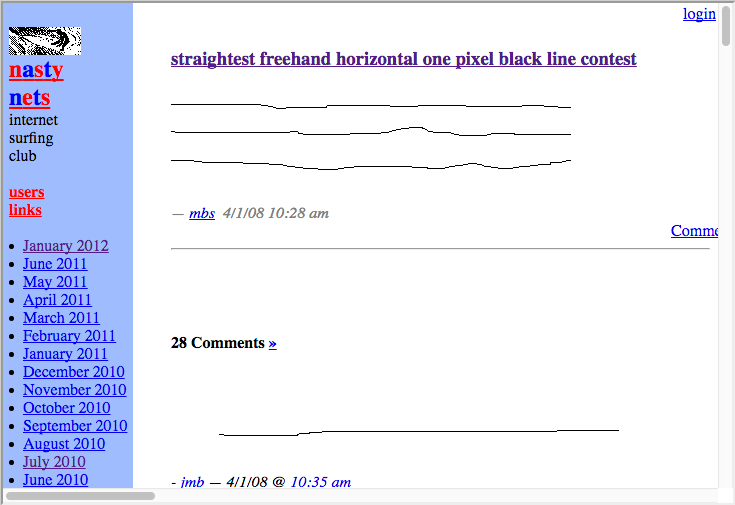
Founded in August 2006 by John Michael Boling, Joel Holmberg, Guthrie Lonergan and Marisa Olson, Nasty Nets was a surf club – a collaboratively run website where members share and comment upon content, either their own work or found material, in a non-hierarchical manner – that lasted until January 2012. Nasty Nets was the first website to call itself an “internet surfing club”.
“Oh boy am I excited to tell you about this!!: Nasty Nets internet surfing club! What’s a surfing club? It’s a hangout for my favorite surfers (and I), an extension of the collecting that’s already been going on, on del.icio.us and elsewhere. Right now it’s mostly a blog, but the idea is that it expands into more of a community – preservation, creation, criticism.. I like putting stuff there because it’s more like two-way sharing, and there’s more of an impulse for discussion (blog comments take on a different nature.) So come on check it out…” Guthrie Lonergan, co-founder, 10/16/2006.
 Spirit Surfing, Kevin Bewersdorf, 2008
The essay is located here: http://web.archive.org/web/20080521094644/http://www.maximumsorrow.com/writing/spiritsurfing.html
In 2008, Kevin Bewersdorf, Marcin Ramocki and Paul Slocum founded the internet surf club Spirit Surfers, www.spiritsurfers.net:
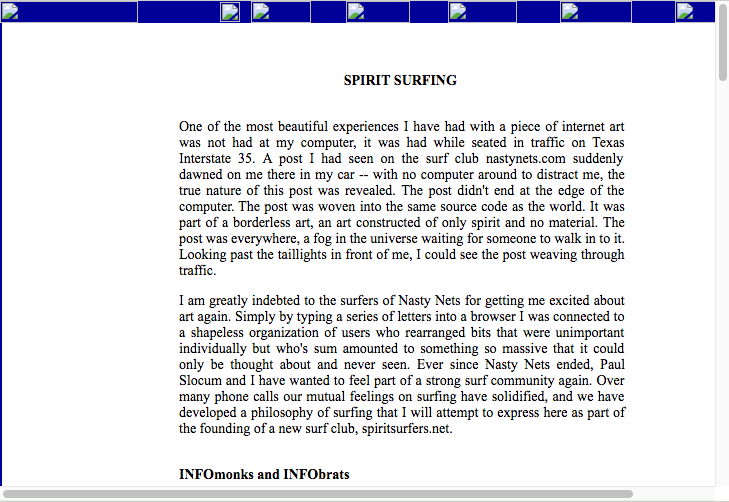
“I am greatly indebted to the surfers of Nasty Nets for getting me excited about art again. Simply by typing a series of letters into a browser I was connected to a shapeless organization of users who rearranged bits that were unimportant individually but who’s sum amounted to something so massive that it could only be thought about and never seen. Ever since Nasty Nets ended, Paul Slocum and I have wanted to feel part of a strong surf community again. Over many phone calls our mutual feelings on surfing have solidified, and we have developed a philosophy of surfing that I will attempt to express here as part of the founding of a new surf club, spiritsurfers.net… [more here].” Kevin Bewersdorf, Spirit Surfing, 2008.
“A hyperlink or list of links is not much of a boon. A link is an entry to another surf, a starting point. A boon is a jewel. These jewels are what separate surf clubs like Spirit Surfers from social bookmarking sites – the posts on Spirit Surfers are jewels publicly removed and reset.” Kevin Bewersdorf, Spirit Surfing, 2008.
“This site is dedicated to the glory of the INFOspirit. Nothing on this website do I retain personal rights or ownership to, since everything I offer up is a rearranged reincarnation of the INFOspirit which binds us all. You may use anything from this site as you see fit, without consulting or asking me.” Kevin Bewersdorf, 2008.
And a final diversion, this time into the world of surf clubs, thanks to Paul Slocum:
http://rhizome.org/editorial/2016/mar/30/catalog-of-internet-artist-clubs

The Real Smiling Rock Last Updated 11-06-2015, Lindsay Lawson, 2015, HD video continually updated as versions, 27’ 25”
“Go to www.ebay.com. Navigate to a category called ‘Everything Else.’ Within it are categories like ‘Weird Stuff’, ‘Totally Bizarre’ and simply ‘Other’. This is the outer limits of eBay, a place for items that defy categorization. Set your minimum bid relatively high at $1,000, for example. Now you are scrolling through the crème of the dregs of online auctions. This is where the smiling rock resides… [more here].”

Repossession Services, ongoing, website
Unique, courtesy The Boss and Reep Dog
The work is located here: http://repossessionservices.info
This exhibition has been made possible by the generous support of Repossession Services.
Biographies
Kevin Bewersdorf
http://www.taotegif.com
“Kev is an artist living in Rockaway Beach NY.” Courtesy Kevin Bewersdorf.
Aleksandra Domanović
Aleksandra Domanović was born in 1981 in Novi Sad, Serbia. She lives and works in Berlin, Germany. “Domanović was awarded the 2014/15 ars viva prize. The ars viva exhibition series presented a selection of works by the three award-winners through 2015 at the Hamburger Kunsthalle, Galerie der Gegenwart, Bonner Kunstverein and Grazer Kunstverein. Domanović’s recent solo exhibitions include: Glasgow International 2014, Gallery of Modern Art, Glasgow (2014); ‘Aleksandra Domanović’, firstsite, Colchester (2014); ‘The Future Was at Her Fingertips’, Tanya Leighton, Berlin (2013); ‘Turbo Sculpture’, SPACE, London (2012); and ‘From yu to me’, Kunsthalle Basel (2012).” Courtesy Tanya Leighton.
CV here.
Harm van den Dorpel
Born 1981 in Zaandam, the Netherlands. Lives and works in Berlin. “His most recent exhibitions include: IOU, Narrative Projects, London (2015); Ambiguity points to the mystery of all revealing, Neumeister Bar-Am, Berlin (2015); 24/7: the human condition, Vienna Biennale, MAK, Vienna (2015); Inflected Objects, Swiss Institute, Milan (2015); Private Settings (commissioned! sculpture), Museum of Modern Art, Warsaw (2014); Art Post-Internet, Ullens Center for Contemporary Art,Beijing (2014); Image Employment, MoMa PS1,NYC (2013); Dissociations @ First Look Series, online commission, The New Museum, New York City (2013); Analogital, Utah Museum of Contemporary Art, Salt Lake City (2013).” Courtesy Narrative Projects.
CV here.
Constant Dullaart
Constant Dullaart (b. 1979, Leiderdorp, Netherlands) studied at the Gerrit Rietveld Academie and Rijksakademie in Amsterdam. Solo exhibitions include Jennifer in Paradise, Futura, Prague; The Censored Internet, Aksioma, Ljubljana (both 2015); Stringendo, Vanishing Mediators at Carroll / Fletcher, London; Brave New Panderers, XPO gallery, Paris (both 2014); Jennifer in Paradise, Future Gallery, Berlin; Jennifer in Paradise, Import Projects, Berlin (2013) and Onomatopoeia, Utah Museum of Contemporary Art, Salt Lake City (2012). Group exhibitions include Electronic Superhighway, Whitechapel Gallery, London (2016); Follow, FACT, Liverpool, UK; Then They Form Us, MCA, Santa Barbara; When I Give, I Give Myself, Van Gogh Museum, Amsterdam (both 2015); Evil Clowns, HMKV, Dortmund, Germany (2014) and Online/Offline/Encoding Everyday Life, transmediale Festival, Berlin (2014). He lives and works between Berlin and Amsterdam.
CV here.
JODI
www.jodi.org (when you get to the website check-out the address bar and tab then reload the page…)
“Jodi, or jodi.org, is a collective of two internet artists: Joan Heemskerk (born 1968 in Kaatsheuvel, the Netherlands) and Dirk Paesmans (born 1965 in Brussels, Belgium). With their first website registered in 1995, JODI.org were amongst the first artists with a presence on the internet. JODI has exhibited around the world, with notable exhibitions and performances including the Centre Pompidou, Paris (2015), the Whitney Museum, NY (2013), the New Museum, NY (2012), Eyebeam NY (2009), Documenta X Kassel (1997).” Courtesy Belenius/Nordenhake.
Lindsay Lawson
Lindsay Lawson (b. 1982, Biloxi, USA) is an American artist based in Berlin. “Lindsay received her BFA in Sculpture from Virginia Commonwealth University, her MFA in New Genres from UCLA, and attended the Städelschule in Frankfurt am Main. Her first feature-length film, The Smiling Rock was shot in Berlin and is currently in post-production during residencies at Trinity Square Video in Toronto as a guest of the Goethe Institut as well as at 1646 in The Hague. Lawson’s most recent solo exhibition, The Inner Lives of Objects, featured 23 vase and panel sculptures filled with various everyday objects. Other recent exhibitions include Home Work at Open Forum, Berlin; January Blues at Frutta Gallery, Rome; A Perfect Lie at Jeanroch Dard, Brussels; Rocks, Stones, and Dust at Justina M. Barnicke Gallery, Toronto. Upcoming exhibitions include ob-iectum sub-iectum at Galerie Tobias Naehring, Leipzig, and a solo exhibition at 1646, The Hague.” Courtesy Canapé Canopy.
CV here.
Olia Lialina
“Born in Moscow. Net Artist, one of net.art pioneers. Writes on New Media, Digital Folklore and Vernacular Web. Co-founder of Geocities Research Institute. Professor at Merz Akademie, Stuttgart. Animated Gif Model. Mother of three – http://art.teleportacia.org/olia.html – mother. @GIFmodel .” Courtesy Olia Lialina.
CV here
Jonas Lund
“Jonas Lund (born 1984, Linköping, Sweden) received an MA at Piet Zwart Institute, Rotterdam. Lund has had solo exhibitions at New Shelter Plan, Copenhagen; BoetzelaerNispen, Amsterdam; Steve Turner, Los Angeles; Showroom MAMA, Rotterdam; W139, Amsterdam. He has participated in ‘Electronic Superhighway 2016-1966’, Whitechapel Gallery, London, UK; ‘The Value of Nothing’, TENT, Rotterdam, NL; The Moving Museum, Istanbul, Turkey; ‘The Crime was almost perfect’, Witte de With, Rotterdam, NL; ‘Out of Office’, Arcade Cardiff, Cardiff, UK; ‘Dread’, De Hallen Haarlem, NL; ‘local.#non.access’, KM Temporaer, Berlin, DE; ‘Fast Connection Search’, IWNY, New York, US; ‘The Paintshow’, Van Abbemuseum, Eindhoven, NL; ‘Public Access Me, First Look’, New Museum, New York, US; ‘HOT, DVD Dead Drop’, Museum of the Moving Image, New York, US; ‘Temporary Stedelijk’, Stedelijk Museum Amsterdam, NL. His work has been written about on Artforum, Rhizome, Huffington Post, Furtherfield, artnet and Wired.” Courtesy Boetzelaer|Nispen.
CV here.
Evan Roth
Evan Roth (b. 1978, Michigan, USA) is an American artist based in Paris. Roth’s work is in the permanent collection of the Museum of Modern Art, New York and has been exhibited at various institutions, including Centre Pompidou, Paris, France; Kunsthalle Wien, Vienna, Austria; Tate Modern, London, UK; and the front page of Youtube. He has received numerous awards, including the Golden Nica from Prix Ars Electronica, Rhizome/The New Museum commissions and the Smithsonian’s Cooper-Hewitt National Design Award. He also co-founded the arts organizations Graffiti Research Lab and the Free Art & Technology Lab.
CV here.
Afterword 2
“Everyone is equal before the machine. I can use it; so can you. It can crush me; the same can happen to you. There is no tradition in technology, no class-consciousness. Everyone can be the machine’s master, or its slave.” László Mohly-Nagy, Reality Of Our Century Is Technology, 1922.
“[artists] must become preoccupied with and even dazzled by the space and objects of our everyday life, either our bodies, clothes, rooms or, if need be, the vastness of Forty-second Street… we should utilise the specific substances of sound, movements, people, odours, touch. Objects of every sort are materials for the new art: paint, chairs, food, electric and neon lights, smoke, water, old socks, a dog, movies, a thousand other things that will be discovered by the present generation of artists… Young artists need no longer say, ‘I m a painter’ or ‘a poet’ or ‘a dancer’. They are simply artists. All of life will be open to them.” Allan Kaprow, The Legacy of Jackson Pollock, 1958.
“They [the Sex Pistols] were also carefully constructed proof that the whole of received hegemonic propositions about the way the world was supposed to work comprised a fraud so complete and venal that it demanded to be destroyed beyond the powers of memory to recall its existence. In those ashes anything would be possible, and permitted: the most profound love, the most casual crime.” Greil Marcus, Lipstick Traces: a secret history of the twentieth century, 1989/2001, p.18.
“We exist in a world of pure communication, where looks don’t matter and only the best writers get laid.” Legba, player in the Multi-User Dungeon (MUD) LamdaMOO, 1994 (quoted in Cluster Mag).
“With more and more media readily available through this unruly archive, the task becomes one of packaging, producing, reframing and distributing; a mode of production analogous not to the creation of material goods, but to the production of social contexts, using existing material.” Seth Price, Dispersion, 2002.
“In Postproduction, I try to show that artists’ intuitive relationship with art history is now going beyond what we call ‘the art of appropriation’, which naturally infers an ideology of ownership, and moving toward a culture of the use of forms, a culture of constant activity of signs based on a collective ideal: sharing.” Nicolas Bourriaud, Postproduction, 2002, p.9.
“The question is no longer: ‘what can we make that is new?’ but ‘ how can we make do with what we have?’ In other words, how can we produce singularity and meaning from the chaotic mess of objects, names and references that constitutes our daily life.” Nicolas Bourriaud, Postproduction, 2002, p.17.
“This site [http://www.spiritsurfers.net] is dedicated to the glory of the INFOspirit. Nothing on this website do I retain personal rights or ownership to, since everything I offer up is a rearranged reincarnation of the INFOspirit which binds us all. You may use anything from this site as you see fit, without consulting or asking me.” Kevin Bewersdorf, 2008.
“If we only look through the interface we cannot appreciate the ways in which it shapes our experience.” Bolter, Gromala: Windows and Mirrors, quoted in Olia Lialina’s Rich User Experience, UX and Desktopization of War, 2015.
“First of all, because it [the Peeman GIF] is an expression of a dislike, when today there is only an opportunity to like…. On vine, when commenting on another user’s video, you are not presented with an empty input form, but are overwriting the suggestion ‘say something nice’… On Tumblr, a ‘close this window’ button becomes ‘Oh, fine’.” Olia Lialina, Rich User Experience, UX and Desktopization of War, 2015.
“The innovators were rebels. Two axioms to bear in mind here: sedition is, by definition, ungrammatical; the artist is the first to recognise when a language is lying.” John Berger, Portraits, 2015, p.83.
“The very act of producing dissonant archives, in real time as events unfold, is now understood by insurgent citizens as a fundamental way of rupturing the spectacle of power, not of simply sharing information… Our contemporary landscape is marked by the overwhelming impulse to document, save and narrate the moment, and significantly, the desire to publicly share this record. While perhaps this impulse is not new, its ubiquity is. Who has the power to record, to speak, and to perform this ‘archival’ activity has radically shifted in the last ten years.” Basel Abbas and Ruanne Abou-Rahme in You Are Here: Art After The Internet, ed. Omar Kholief, 2015.
“It seems as if Flusser’s* concept of the totalitarian apparatus, hypothesized in 1985, has today come to fruition in the form of climate change, the intelligent war machine, the surveillance state, factory automation and the seemingly unavoidable, locked in place, systemic flows that forecast an inevitable and catastrophic end to the anthropocene.
“Can communications technology serve as a vehicle for social change? How does one negotiate the envisioning power of technical images, which unlock unprecedented degrees of creative agency for humanity, against what appears to be the immanent downwards trajectory of human value through technological progression? Is there a possibility within the dialogical fabric of networked culture to enact a meaningful social restructuring and so push back against the totalitarianism of the apparatus?” Joshua Citarella, 2016, in the essay that accompanies the Desh Mesh exhibition at Carroll / Fletcher (14 April 2016 – 25 May 2016). *Vilem Flusser, Into the Universe of Technical Images (1985).